


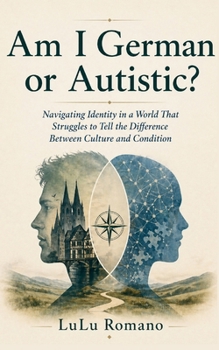
Am I German or Autistic?: Navigating Identity in a World That Struggles to Tell the Difference Between Culture and Condition

This is not a typical book. Many pages hold just a single line. A single thought. A single feeling.
Because sometimes, that's all it takes to be understood.
Am I German or Autistic?
Navigating Identity in a World That Struggles to Tell the Difference Between Culture and Condition
A gentle, honest, and quietly powerful exploration of identity, neurodivergence, and belonging.
Have you ever felt different- but couldn't quite explain why?
Have you ever been drawn to a place, a culture, a way of thinking... as if it already knew you?
This book begins in that space.
Written with intimacy and reflection, Am I German or Autistic? is not about choosing a label it's about questioning the need for one.
Blending personal insight, cultural curiosity, and neurodivergent awareness, this book invites you into a deeply human experience: trying to understand yourself in a world that often prefers simple explanations.
This is not a clinical guide. It is not a diagnostic manual. And it does not try to define you.
Instead, it offers something quieter and perhaps more meaningful.
Space.
Space to explore identity without pressure. Space to notice patterns without judgment. Space to sit with questions that don't need immediate answers.
Through short, thoughtful passages, this book speaks to those who think deeply, feel intensely, and have always sensed that their inner world doesn't quite match what others see.
It's for the ones who overanalyze conversations long after they end. For the ones who find comfort in structure-but also feel overwhelmed by it. For the ones who have learned to adapt, but still wonder what feels truly natural.
And for those who have ever asked themselves-quietly or out loud:
Is this who I am... or just how I've learned to be?
Written from the perspective of a late-diagnosed autistic woman with a deep and intuitive connection to German culture, this book does not try to separate culture from condition with certainty.
Instead, it explores the space where they meet.
Where habits, preferences, communication styles, and ways of thinking begin to overlap. Where identity becomes less about categories and more about experience.
This is not about romanticizing difference. And it's not about reducing it either.
It's about paying attention.
Listening closely to yourself. Noticing what feels true. Allowing contradictions to exist without needing to resolve them immediately.
Because sometimes, understanding doesn't come from choosing one answer-
but from allowing multiple truths to sit side by side.
This book will not give you a final conclusion.
But it may give you something else:
Recognition. Clarity. And a sense that you are not alone in the way you experience the world.
If you have ever felt like you exist between explanations... If you have ever questioned where you belong... If you have ever searched for yourself in places that felt strangely familiar...
This book is for you.
Because identity is not always something you find. Sometimes, it's something you slowly come to understand.
Customer Reviews
ThriftBooks ® and the ThriftBooks ® logo are registered trademarks of Thrift Books Global, LLC
