
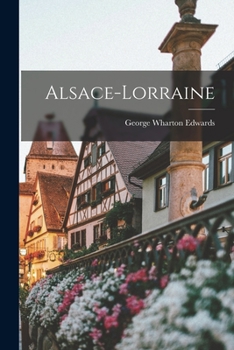
"Alsace-Lorraine" is an evocative exploration of one of Europe's most storied and contested regions. Written by George Wharton Edwards, this work provides a rich tapestry of the cultural, historical, and architectural heritage of a territory that has long stood at the crossroads of French and German influence. Edwards, a noted artist and writer, captures the unique spirit of the provinces through detailed observations of their landscapes, cities, and people.
The narrative delves into the complex history of the region, from its medieval origins to the aftermath of the Great War, reflecting on the enduring resilience of its inhabitants. Readers are guided through the charming streets of Strasbourg and Metz, the picturesque villages of the Vosges, and the fertile plains that define the local character. Edwards emphasizes the artistic and social traditions that have persisted despite centuries of political shifts and conflict.
This volume serves as both a historical record and a travel narrative, celebrating the beauty and distinct identity of a land that remains central to the identity of Western Europe. It is an essential read for those interested in European history, regional geography, and the timeless allure of the Franco-German borderlands.
This work has been selected by scholars as being culturally important, and is part of the knowledge base of civilization as we know it. This work was reproduced from the original artifact, and remains as true to the original work as possible. Therefore, you may see the original copyright references, library stamps (as most of these works have been housed in our most important libraries around the world), and other notations in the work.
This work is in the public domain in the United States of America, and possibly other nations. Within the United States, you may freely copy and distribute this work, as no entity (individual or corporate) has a copyright on the body of the work.
As a reproduction of a historical artifact, this work may contain missing or blurred pages, poor pictures, errant marks, etc. Scholars believe, and we concur, that this work is important enough to be preserved, reproduced, and made generally available to the public. We appreciate your support of the preservation process, and thank you for being an important part of keeping this knowledge alive and relevant.

