


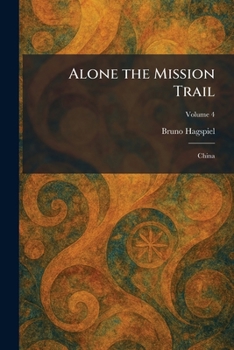
Alone the Mission Trail: China

"Alone the Mission Trail IV. China" is an evocative and detailed firsthand account of missionary life and travel across China during the early 20th century. Written by Bruno Hagspiel, this fourth volume in his travel series offers a unique perspective on the intersection of Catholic faith and East Asian culture. Through his observations, Hagspiel provides a comprehensive look at various mission stations, the spiritual challenges faced by practitioners, and the vast geographical and social landscape of a nation in transition.
The narrative captures the essence of the missionary spirit, detailing the dedication required to navigate remote regions and establish religious communities. Hagspiel's writing is more than a religious record; it is a valuable travelogue that depicts the daily lives, traditions, and resilience of the people he encountered. Readers will find deep insights into the complexities of cross-cultural engagement and the historical role of Western missions in Asia. With its rich descriptions and historical significance, "Alone the Mission Trail IV. China" serves as an important document for those interested in religious history, missiology, and the cultural history of early 20th-century China.
This work has been selected by scholars as being culturally important, and is part of the knowledge base of civilization as we know it. This work was reproduced from the original artifact, and remains as true to the original work as possible. Therefore, you may see the original copyright references, library stamps (as most of these works have been housed in our most important libraries around the world), and other notations in the work.
This work is in the public domain in the United States of America, and possibly other nations. Within the United States, you may freely copy and distribute this work, as no entity (individual or corporate) has a copyright on the body of the work.
As a reproduction of a historical artifact, this work may contain missing or blurred pages, poor pictures, errant marks, etc. Scholars believe, and we concur, that this work is important enough to be preserved, reproduced, and made generally available to the public. We appreciate your support of the preservation process, and thank you for being an important part of keeping this knowledge alive and relevant.
Customer Reviews
ThriftBooks ® and the ThriftBooks ® logo are registered trademarks of Thrift Books Global, LLC
