


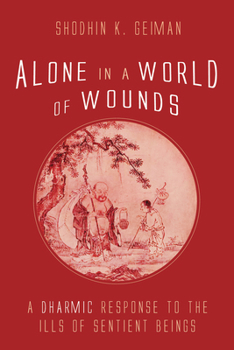
Alone in a World of Wounds: A Dharmic Response to the Ills of Sentient Beings
No Customer Reviews

When Buddhism came to the West in the 1960s, many were eager to adapt it straightaway to the prevailing social and intellectual currents of its new home. One of those adaptations was the creation of a "socially engaged" Buddhism that could stand alongside similar developments in Christian and Jewish thought. It seemed like a good idea at the time. Beginning with what the tradition calls the path of "the holy life," a life free of every attachment to self and the delusions to which it gives rise, Geiman draws attention to the unique contribution the Dharma makes to one's understanding of the world, one's place within it, and the nature of wise and compassionate action in the face of human hardship. Along the way, he shows the limits of using the teaching of the Buddha and the Dharma Ancestors as support for social and political agendas of any kind. What emerges is a description of a noble life free of pretense and guile, which fearlessly and unshakably bears witness to the truth of our conditioned nature in the midst of human hardship--a life best described as standing alone in a world of wounds.
Format:Hardcover
Language:English
ISBN:1666714976
ISBN13:9781666714975
Release Date:June 2022
Publisher:Cascade Books
Length:286 Pages
Weight:1.30 lbs.
Dimensions:0.8" x 6.0" x 9.0"
Customer Reviews
0 rating
Copyright © 2026 Thriftbooks.com
Terms of Use | Privacy Policy | Do Not Sell/Share My Personal Information | Cookie Policy | Cookie Preferences | Accessibility Statement
ThriftBooks ® and the ThriftBooks ® logo are registered trademarks of Thrift Books Global, LLC
ThriftBooks ® and the ThriftBooks ® logo are registered trademarks of Thrift Books Global, LLC
