


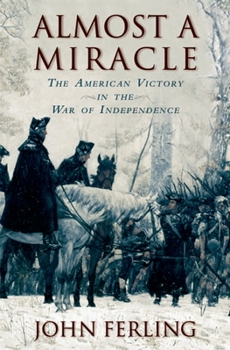
Almost a Miracle: The American Victory in the War of Independence


Select Format
Select Condition 
Book Overview
In this gripping chronicle of America's struggle for independence, award-winning historian John Ferling transports readers to the grim realities of that war, capturing an eight-year conflict filled with heroism, suffering, cowardice, betrayal, and fierce dedication. As Ferling demonstrates, it was a war that America came much closer to losing than is now usually remembered. General George Washington put it best when he said that the American victory was "little short of a standing miracle."
Almost a Miracle offers an illuminating portrait of America's triumph, offering vivid descriptions of all the major engagements, from the first shots fired on Lexington Green to the surrender of General Cornwallis at Yorktown, revealing how these battles often hinged on intangibles such as leadership under fire, heroism, good fortune, blunders, tenacity, and surprise. The author paints sharp-eyed portraits of the key figures in the war, including General Washington and other American officers and civilian leaders. Some do not always measure up to their iconic reputations, including Washington himself. Others, such as the quirky, acerbic Charles Lee, are seen in a much better light than usual. The book also examines the many faceless men who soldiered, often for years on end, braving untold dangers and enduring abounding miseries. The author explains why they served and sacrificed, and sees them as the forgotten heroes who won American independence. Ferling's narrative is also filled with compassion for the men who comprised the British army and who, like their American counterparts, struggled and died at an astonishing rate in this harsh war. Nor does Ferling ignore the naval war, describing dangerous patrols and grand and dazzling naval actions.
Finally, Almost a Miracle takes readers inside the legislative chambers and plush offices of diplomats to reveal countless decisions that altered the course of this war. The story that unfolds is at times a tale of folly, at times one of appalling misinformation and confusion, and now and then one of insightful and dauntless statesmanship.
Almost a Miracle offers an illuminating portrait of America's triumph, offering vivid descriptions of all the major engagements, from the first shots fired on Lexington Green to the surrender of General Cornwallis at Yorktown, revealing how these battles often hinged on intangibles such as leadership under fire, heroism, good fortune, blunders, tenacity, and surprise. The author paints sharp-eyed portraits of the key figures in the war, including General Washington and other American officers and civilian leaders. Some do not always measure up to their iconic reputations, including Washington himself. Others, such as the quirky, acerbic Charles Lee, are seen in a much better light than usual. The book also examines the many faceless men who soldiered, often for years on end, braving untold dangers and enduring abounding miseries. The author explains why they served and sacrificed, and sees them as the forgotten heroes who won American independence. Ferling's narrative is also filled with compassion for the men who comprised the British army and who, like their American counterparts, struggled and died at an astonishing rate in this harsh war. Nor does Ferling ignore the naval war, describing dangerous patrols and grand and dazzling naval actions.
Finally, Almost a Miracle takes readers inside the legislative chambers and plush offices of diplomats to reveal countless decisions that altered the course of this war. The story that unfolds is at times a tale of folly, at times one of appalling misinformation and confusion, and now and then one of insightful and dauntless statesmanship.
Format:Hardcover
Language:English
ISBN:0195181212
ISBN13:9780195181210
Release Date:June 2007
Publisher:Oxford University Press, Incorporated
Length:704 Pages
Dimensions:6.6" x 2.2" x 9.3"
Related Subjects
Colonial Period History Military Modern (16th-21st Centuries) Revolution & FoundingCustomer Reviews
4 ratings
This Is How It Was!
Published by Thriftbooks.com User , 19 years ago
In his masterful work, Almost A Miracle, author John Ferling yanks you out of your favorite chair, hurling you back in time to be there with Washington, in the thick of battle, the smell of gunpowder thick in your nostrils, men and horses dying all around you, cannon firing as though they were announcing Judgment Day. This is the War for Independence, sans make believe, sham, romantics or posturing. This is how it was for the colonists in their struggle, and Ferling spares us no pain or agony yet reminds of us of what a heroic breed we can be. Though I have read many accounts of this period in our history, none comes closer to the truth than Almost a Miracle. Get it, read it, live it. It should be required reading for all Americans!
Excellent military history of the Revolution.
Published by Thriftbooks.com User , 19 years ago
This book deals almost exclusively with the military aspects of the American Revolution. As such, it is excellent. I found it really a page-turner and stayed up to nearly 1am two nights to finish it. The book does not cover the political aspects of the war - for that the best book I've seen is Middlekauff's "Glorious Cause" (Oxford University Press). Ferling is especially good at pointing out the military blunders made by both sides. In fact, at times it's almost a comedy of errors. It's a wonder that either side won!
An Epic Chronicle of the Revolutionary War
Published by Thriftbooks.com User , 19 years ago
Bringing to this book nearly forty years of teaching and writing experience, John Ferling is one of the premier authorities on the history of early America. Ferling is the author of numerous books and articles on the American Revolution, including Setting the World Ablaze: Washington, Adams, Jefferson, and the American Revolution; The World Turned Upside Down: The American Victory in the War of Independence; and A Leap in the Dark: The Struggle to Create the American Republic (2003), which won the Fraunces Tavern Book Award as the year's best book on the American Revolution. In Almost a Miracle, Ferling, professor emeritus at the University of West Georgia, has written an engrossing, fast-paced military history of the Revolutionary War, from the first shots fired at Lexington and Concord to the surrender of Cornwallis at Yorktown. At the end of this eight-year war, George Washington remarked that the American victory was "little short of a standing miracle." How did America emerge victorious? Ferling's assessment of George Washington is a double-edged sword. Often out-generaled, Washington made several egregious blunders that, had the British commander (Howe) acted aggressively, would have ended the war almost before it began. Washington also was slow to recognize the importance of Britain's "Southern Strategy," believing that military action in the "backwater" South was of small importance. And yet, Washington's Fabian strategy and tactics (employing frequent "hit-and-run" retreats and a defensive war of posts), held the tattered American forces together, through brutal winters at Valley Forge and Morristown, to live and fight another day. "Washington alone," writes Ferling, "had the preparation for the office of commander in chief at the outset of the war and the intelligence, temper, and character necessary to grow in the office. His defects notwithstanding, fortune smiled on the infant nation when Washington was selected to lead it into the war." Ferling points out that, although there was no turning point in the Revolutionary War, there were, however, significant victories that enhanced the American cause, such as the battles of Bunker Hill, Trenton and Princeton, Saratoga, and King's Mountain. Inclement weather was also an important factor, causing both the British and the Americans to revise their battle plans, resulting in missed opportunities for success or narrow escapes from disaster. (Providence seems to have been confused as to which side to favor.) "Battles often hinged on intangibles," writes Ferling, "such as leadership under fire, heroism, good fortune [luck?], blunders, resiliency, planning, tenacity, and surprise." Above all, Ferling asserts, "French help [financial and military, especially the French fleet] was the single most important factor in determining the outcome of the War of Independence." While this is true, one should not sell short the sacrifices made by numerous soldiers and sailors who fought in the pa
Perspective on the War of Independence
Published by Thriftbooks.com User , 19 years ago
Almost A Miracle is terrific telling of the Revolution, including its details, strategies, participants, daily human realities, the roles of luck and chance, and the might-have-beens of history. As a New Yorker I could actually picture Ferling's recreation of Washington's eight-abreast march down the Post Road as it proceeded from place to place and finally to Broadway as the last Continentals, black and white, re-took York Island in November 1783. That's good writing. I finally learned why a small city in South Carolina would be named for a Rhode Islander. Buffs and newcomers alike will enjoy the flow and perspective in Ferling's version of this oft-told tale. No Founding Era collection could be complete without it. Reviews require criticisms too, and I have two: a book like this would benefit greatly by an Appendix or two that included a timeline and a cast of characters (sort of like White's Bitter Ocean). Secondly, all books have typos and grammatical faux pas - this one has too many.
Copyright © 2026 Thriftbooks.com
Terms of Use | Privacy Policy | Do Not Sell/Share My Personal Information | Cookie Policy | Cookie Preferences | Accessibility Statement
ThriftBooks ® and the ThriftBooks ® logo are registered trademarks of Thrift Books Global, LLC
ThriftBooks ® and the ThriftBooks ® logo are registered trademarks of Thrift Books Global, LLC
