


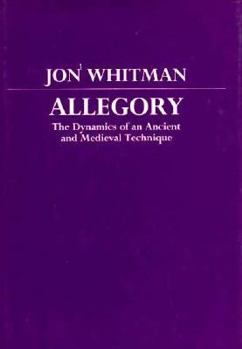
Allegory: The Dynamics of an Ancient and Medieval Technique
No Customer Reviews

Select Format
Select Condition 
Book Overview
Allegory is both a strategy for interpreting texts and a method for composing them. This book investigates the interplay between these interpretive and compositional traditions at critical points in their development. Jon Whitman analyzes a range of works in which the allegorical impulse develops, from the Stoic moral essay and the Roman mythological epic to the Neoplatonic exegetical treatise and the Christian spiritual encyclopedia. By examining important changes in approach to the logic of a text, the design of the world, and the organization of events, Whitman shows how the interpretive and poetic strategies of allegory increasingly overlap and broaden in scope in antiquity and the early Middle Ages. He explains how this interaction acquires an intensive form in the twelfth-century Cosmographia, which explicates the story of creation by devising allegorical characters to act out the narrative. Relating this early convergence of analytic and imaginative methods to broader critical concerns, Whitman shows how allegory constantly promotes the reassessment of its own formulations, a process that stimulates the complex allegorical movement of the late Middle Ages. Jon Whitman currently teaches English literature at the Hebrew University of Jerusalem.
Format:Hardcover
Language:English
ISBN:0674016459
ISBN13:9780674016453
Release Date:July 1987
Publisher:Harvard University Press
Length:281 Pages
Weight:1.15 lbs.
Dimensions:6.1" x 0.6" x 9.3"
Customer Reviews
0 rating
Copyright © 2026 Thriftbooks.com
Terms of Use | Privacy Policy | Do Not Sell/Share My Personal Information | Cookie Notice | Cookie Preferences | Accessibility Statement
ThriftBooks ® and the ThriftBooks ® logo are registered trademarks of Thrift Books Global, LLC
ThriftBooks ® and the ThriftBooks ® logo are registered trademarks of Thrift Books Global, LLC
