


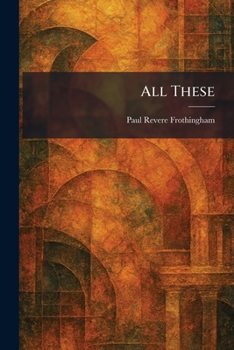
All These

Select Format
Select Condition 
Book Overview
"All These" is a compelling collection of biographical essays and spiritual reflections authored by the esteemed Paul Revere Frothingham. As a prominent figure in the Unitarian church, Frothingham brings a unique perspective to the lives of influential leaders and thinkers, offering deep insights into their character and contributions. Through a series of thoughtful sketches, the author explores the intersection of faith, intellect, and social responsibility.
The book features examinations of notable individuals such as John Ruskin, Edward Everett Hale, and William Everett, alongside broader meditations on ethics and the religious life. Written with the eloquence and moral clarity characteristic of Frothingham's pulpit oratory, "All These" serves as both a historical record of significant figures and a timeless exploration of the virtues that define a meaningful life. This collection captures the essence of early 20th-century liberal religious thought, making it an invaluable resource for readers interested in biography, theology, and the development of ethical leadership in a changing world.
This work has been selected by scholars as being culturally important, and is part of the knowledge base of civilization as we know it. This work was reproduced from the original artifact, and remains as true to the original work as possible. Therefore, you may see the original copyright references, library stamps (as most of these works have been housed in our most important libraries around the world), and other notations in the work.
This work is in the public domain in the United States of America, and possibly other nations. Within the United States, you may freely copy and distribute this work, as no entity (individual or corporate) has a copyright on the body of the work.
As a reproduction of a historical artifact, this work may contain missing or blurred pages, poor pictures, errant marks, etc. Scholars believe, and we concur, that this work is important enough to be preserved, reproduced, and made generally available to the public. We appreciate your support of the preservation process, and thank you for being an important part of keeping this knowledge alive and relevant.
Customer Reviews
ThriftBooks ® and the ThriftBooks ® logo are registered trademarks of Thrift Books Global, LLC
