


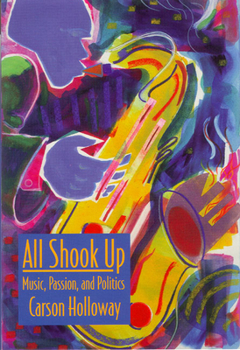
All Shook Up: Music, Passion, and Politics

Select Format
Select Condition 
Book Overview
No Synopsis Available.
Format:Hardcover
Language:English
ISBN:1890626333
ISBN13:9781890626334
Release Date:December 2008
Publisher:Spence Publishing Company
Length:232 Pages
Weight:1.17 lbs.
Dimensions:9.0" x 0.8" x 6.3"
Customer Reviews
5 ratings
Excellent Introduction
Published by Thriftbooks.com User , 18 years ago
"All Shook Up" is an excellent introduction to the important roll music plays in forming societies. The author carefully progresses from Socrates to Nietzsche to show the significance of both the differences and similarities in their philosophies on music. He makes a strong case that the effects of music on society are more significant than even the "conservative moralizers" imagine.
Does Music Matter?
Published by Thriftbooks.com User , 21 years ago
In the early 1970s amidst the Indian gurus at the Whole Earth Festival at the University of California Davis, I met a young American who admired Ravi Shakar and was, not surprisingly, studying the sitar. He assured me that all of the ragas composed by traditional Indian musicians were designed to enhance or induce spiritual states. Thus, for the Hindu musical tradition of the ragas, the concept that instrumental music affects the human mind and spirit is a basic presupposition. Indeed, the primary purpose of the music is not entertainment but Hindu spiritual development. Nevertheless, it seems that in the modern West, most Christians and secularists alike reject with asperity this elementary insight that the most influential message of music is found in its rhythm, melody and harmony rather than in its lyrics. Therefore, we owe a debt of gratitude to Carson Holloway for this groundbreaking recovery of the role of music in the moral education of human beings. He contrasts the deep concern with music as a moral force of the ancients represented by Plato and Aristotle and of certain moderns such as Rousseau and Nietzsche with the lack of such interest of other moderns such as Hobbes and Locke. Holloway acknowledges Allan Bloom's recognition of the anti-philosohical influence of rock music but finds Bloom's analysis wanting. I think that Holloway succeeds in advancing a rational understanding of the subject. Unfortunately, an objective appraisal of his work is difficult for many because music lies on the fault line of the culture war between those who see the Judeo-Christian ethic as corresponding to the natural order of creation and those whose ethic denies the existence of such an order in favor of human autonomy. Defenders of the Judeo-Christian ethic are typically disarmed on the musical front by their failure to understand what any random student of Ravi Shankar knows: Music directly affects the soul without regard for the rational content of lyrics, which are quite optional. Thus, the sounds of the music, i.e., its musical form, may enhance or detract from any lyrics. Indeed, the form of the music may well be more powerful than the words and overwhelm their message. Holloway makes a useful contribution to our understanding of how music affects us beginning with this recognition that music does affect our souls in powerful ways that matter in both ethics and politics.
the fight over music
Published by Thriftbooks.com User , 23 years ago
Holloway's book is a wonderful introduction to what the history of western political philosophy says about the role of music in shaping people's character. The belief that music has a role in forming the character has always been a controversal stance, starting with Plato, and remains one still today. One only has to be reminded of Allan Bloom's chapter on Rock music and the reaction that section provoked shows how powerful this theme remains today. Liberals (ancient and modern, capitalist or not) don't like the idea that music plays a role in character formation.. and what Holloway's book does shows the reader what the big stars of western philosophy has to say on this subject. Holloways argues by ignoring the power of music in the formation of character of the young especially, contemporary society and the music it has bread.. has lead to extremes both in music and people's character.. and both for the worse.
Cogent and compelling
Published by Thriftbooks.com User , 24 years ago
Mr. Holloway's book is a welcome addition to the discussion of culture and morality. Far from simply saying what is good and what is not, he shows how we have arrived at current opinions about music and it's place in our cultural life, and why what the likes of Plato and Aristotle had to say has relavence for today. This is a well reasoned and thoughtful treatise that should be read by everyone who is concerned with the current social fabric.It is refreshing to have a political scientist regard music as a serious force in that very discipline. Those who disagree with him will do so not because his arguments do not make sense, but because they do not like his conclusions, i.e. they are fulfilling the very dictum of contemporary politics - hold any opinion you want to, as long as you don't insist it is the right one.
music 's reflection of a spoiled society
Published by Thriftbooks.com User , 25 years ago
Holloway effectively illustrates the assertions of notable philosphers concerning the importance of music in society, with particular reference to the rhythm and tone of the music. Philosophers ranging Aristotle to Rousseau understood the importance of music in arousing or pacifying emotions. Holloway offers a very convincing illustration of the effects of music upon the characters of individuals. Music is filled with explicit language, verbal images of gratuituous sexual conduct, and the pleasurable experiences of narcotic abuses. In being over-exposed to this kind of music, the current generation has become accustomed to expecting extreme methods of gratifying oneself. This over-gratification has lead to an experimentation with new methods of gratification, more extreme and effective than the preceding methods. Holloway doesn't really discuss what should be done to remedy this trend nor does he suggest censorship. Also, the book was lacking a global philosophical approach as asian philosophical teachings concerning music were omitted from the book.
Copyright © 2026 Thriftbooks.com Terms of Use
| Privacy Policy | Do Not
Sell/Share My Personal Information | Cookie Policy | Cookie Preferences | Accessibility Statement
ThriftBooks® and the ThriftBooks® logo are registered trademarks of Thrift Books Global, LLC
ThriftBooks® and the ThriftBooks® logo are registered trademarks of Thrift Books Global, LLC
