


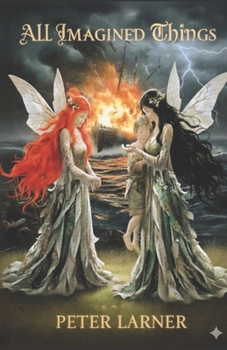
All Imagined Things
No Customer Reviews

This lyrical, evocative tale is rich with natural imagery and a mythic tone. It functions as both a modern faery tale and a work of magical realism, in which a forest itself is a living, whispering entity, where stories drift like pollen on the wind.
The story, conveyed without spoken words, is poetic and whimsical, yet tinged with melancholy, carrying deliberate echoes of Shakespeare, Yeats, and Keats. References to the orphaned Indian boy resonate with 'A Midsummer Night's Dream'. However, it is set in a later period, comparing the dying British Empire to the slow decay of an alder.
This mystical tale of an orphaned boy living with his two peculiar guardians in their dilapidated home unfolds in two parallel narratives: one set in the reality of London after World War II, the other rooted in Irish folklore and faery enchantment. The opening lines from each chapter persuade the reader to reconsider earthly reasoning, hinting that the protagonist, Joseph, is a changeling, a child of both faery and human realms. Through war and shipwreck, from his faery kingdom on Galway's Knockma Hill, the faery Finnbhearr severs Joseph's human ties, except for the boy's grandfather William, who, in his declining health, under Finnbhearr's influence, appoints two fairies to help raise the boy to maturity. The second narrative recounts the boy's earthly life, beginning with Joseph's childhood as an orphan. Having lost his mother at birth, the boy, accompanied by his father, a Captain serving in the British Army in India, travels to England in 1939 when their ship is sunk by a U-boat, killing his father. Joseph survives but, with his identity unknown, is fostered by two Irish women in London's blitzed East End.
As the Second World War begins, the boy is evacuated to Devon, under the care of Mr and Mrs O'Brien, at Home Farm. When the war ends, Joseph is sent back to London to be cared for by foster parents, two women who served in the WRNS. Tania and Fay introduce Joseph to an elderly man who lives on the upper two floors. William is dying from cancer. After Joseph marries at 30, he and his wife return from their honeymoon to discover the two women have disappeared, leaving a letter revealing that William was his grandfather, who had inherited the house from his father. The house has been left to Joseph, whilst the women who raised him have returned to their homeland in Ireland.
The story opens in 2026, when Joseph, aged 91, is invited to speak at a local school about his experiences as a World War II evacuee. After exploring two versions of his life, the story concludes in the present day, with Joseph lying in a hospital bed, expecting to pass away. He recalls a visit earlier in the day from two ageless women who sang Yeats's lullaby The Stolen Child at his bedside. Were the visitors Tania and Fay? The story ends in ambiguity, inviting the reader to choose between earthly truth and a mythic possibility that faery emissaries came to reclaim a descendant of King Finnbhearr.
1]Come away, O human child
To the waters and the wild.
With a faery, hand in hand,
For the world's more full of weeping than you can understand. 1] The Stolen Child by W. B. Yeats, Collected Poems, The Folio Society, London, 2007, p. 20.
The story, conveyed without spoken words, is poetic and whimsical, yet tinged with melancholy, carrying deliberate echoes of Shakespeare, Yeats, and Keats. References to the orphaned Indian boy resonate with 'A Midsummer Night's Dream'. However, it is set in a later period, comparing the dying British Empire to the slow decay of an alder.
This mystical tale of an orphaned boy living with his two peculiar guardians in their dilapidated home unfolds in two parallel narratives: one set in the reality of London after World War II, the other rooted in Irish folklore and faery enchantment. The opening lines from each chapter persuade the reader to reconsider earthly reasoning, hinting that the protagonist, Joseph, is a changeling, a child of both faery and human realms. Through war and shipwreck, from his faery kingdom on Galway's Knockma Hill, the faery Finnbhearr severs Joseph's human ties, except for the boy's grandfather William, who, in his declining health, under Finnbhearr's influence, appoints two fairies to help raise the boy to maturity. The second narrative recounts the boy's earthly life, beginning with Joseph's childhood as an orphan. Having lost his mother at birth, the boy, accompanied by his father, a Captain serving in the British Army in India, travels to England in 1939 when their ship is sunk by a U-boat, killing his father. Joseph survives but, with his identity unknown, is fostered by two Irish women in London's blitzed East End.
As the Second World War begins, the boy is evacuated to Devon, under the care of Mr and Mrs O'Brien, at Home Farm. When the war ends, Joseph is sent back to London to be cared for by foster parents, two women who served in the WRNS. Tania and Fay introduce Joseph to an elderly man who lives on the upper two floors. William is dying from cancer. After Joseph marries at 30, he and his wife return from their honeymoon to discover the two women have disappeared, leaving a letter revealing that William was his grandfather, who had inherited the house from his father. The house has been left to Joseph, whilst the women who raised him have returned to their homeland in Ireland.
The story opens in 2026, when Joseph, aged 91, is invited to speak at a local school about his experiences as a World War II evacuee. After exploring two versions of his life, the story concludes in the present day, with Joseph lying in a hospital bed, expecting to pass away. He recalls a visit earlier in the day from two ageless women who sang Yeats's lullaby The Stolen Child at his bedside. Were the visitors Tania and Fay? The story ends in ambiguity, inviting the reader to choose between earthly truth and a mythic possibility that faery emissaries came to reclaim a descendant of King Finnbhearr.
1]Come away, O human child
To the waters and the wild.
With a faery, hand in hand,
For the world's more full of weeping than you can understand. 1] The Stolen Child by W. B. Yeats, Collected Poems, The Folio Society, London, 2007, p. 20.
Format:Paperback
Language:English
ISBN:B0GYD2C1F4
ISBN13:9798245982335
Release Date:April 2026
Publisher:Independently Published
Length:194 Pages
Weight:0.51 lbs.
Dimensions:0.4" x 5.5" x 8.5"
Customer Reviews
0 rating
Copyright © 2026 Thriftbooks.com
Terms of Use | Privacy Policy | Do Not Sell/Share My Personal Information | Cookie Notice | Cookie Preferences | Accessibility Statement
ThriftBooks ® and the ThriftBooks ® logo are registered trademarks of Thrift Books Global, LLC
ThriftBooks ® and the ThriftBooks ® logo are registered trademarks of Thrift Books Global, LLC
