


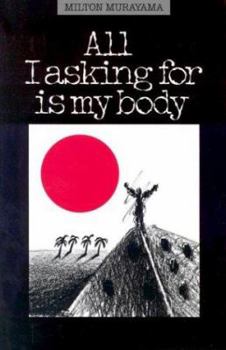
All I Asking for Is My Body


Select Format
Select Condition 
Book Overview
From the Afterword by Franklin S. Odo:
The most important feature of Milton Murayama's brilliant All I Asking for Is My Body is the quality of the storytelling. It deserves thorough discussion and criticism among literary professionals and students. The work has a further genius, however, in its evocation of several major topics in modern Hawaiian history, specifically during the 1930s, the decade before United States involvement in World War II. I suggest that Murayama's novel provides us with valuable insights into the worlds of language, sugar plantation history, and the second-generation Japanese Americans, the nisei. . . . Critic Rob Wilson noted: "Part of the accomplishment of the novel is that the language ranges from the vernacular to the literate and standard, and so reflects the cultural and linguistic diversity of Hawaii." In the novel, Murayama uses standard English and pidgin. In real life, the narrator Kiyo explains, "we spoke four languages: good English in school, pidgin English among ourselves, good or pidgin Japanese to our parents and the other old folks." The wonder is that Murayama emerged using any one of the languages well. For most, that experience proved to be an insuperable barrier to good creative writing. . . . All I Asking for Is My Body is the most compelling work done on the Hawaii nisei experience. Murayama understood his theme to be "the Japanese family system vs. individualism, the plantation system vs. individualism. And so the environments of the family and the plantation are inseparable from the theme." Fortunately for us as readers, however, he understood that the story was the key ingredient; that anything less would simply add to the sociological study of the plantation and the Japanese family in Hawaii.Format:Paperback
Language:English
ISBN:0824811720
ISBN13:9780824811723
Release Date:May 1988
Publisher:University of Hawaii Press
Length:120 Pages
Weight:0.55 lbs.
Dimensions:0.3" x 6.0" x 9.0"
Customer Reviews
5 ratings
Excellent illumination of the Japanese experience in Hawaii
Published by Thriftbooks.com User , 23 years ago
Despite the title and despite the comment of an earlier reviewer, "All I Asking for Is My Body" is an extremely well written story that perfectly captures the Japanese-American experience in Hawaii. It is clear that Murayama himself experienced many of the things that his protagonist does, as his commentary on plantation life, reactions to the Pearl Harbor bombing, the traditional Japanese family system, and the importance of filial piety rings strong and true. Perhaps my only complaint about this book was its brevity, I wish Murayama would've gone into more detail at points, and the ending itself seemed a little too pat given the hardships the family had gone through together for years (decades really). I found myself wanting to know what Kiyoshi would have done had he not suddenly figured out the key to craps and freed his family from debt through gambling. After following his own beliefs into the army, would he have been willing or able to settle for plantation life again after the war?One of the more interesting aspects of the book is the confidence all of the characters have in themselves as individuals. In contrast to John Okada's "No-No Boy," where the protagonist spends the entire novel searching for an identity (rather than feeling Japanese or feeling American he feels largely empty instead), that is not an issue in this story. Kiyoshi has a very strong family and community structure around him.All I Asking for Is My Body is an excellent book, told very effectively through the eyes of a perceptive nisei who is often in difficult situations and forced to make tough choices. The experience of plantation workers in Hawaii is an oft-overlooked aspect of American history, but Murayama does a great job of bringing the time period to life again with a fluidity and grace that makes this story memorable and easy to understand, even for today's readers, who are removed from the time and place of this novel's action.
Not to be Forgotten
Published by Thriftbooks.com User , 24 years ago
This coming-of-age story feels *very* immediate and gripping, and yet, at least for this white female urban mainland reader, the experiences and world depicted are VERY far-removed from what I know. So, Murayama gives you that sense of urgent involvement that makes something really fun to read, while letting you look into a really intense world that you may nothing about before reading this book -- namely, sugar plantation life for Japanese immigrants in Hawaii in the 1940s. A real thumbs up, and a book I'll never forget.
The reviewer above me obviously doesn't speak pidgin.
Published by Thriftbooks.com User , 26 years ago
Poor grammar? The book's pidgin English may often a nebulous maze to walk through for an untrained reader, but I find this book a lyrical joy to read everytime.The novel itself is a bildungsroman of heartfelt and often painful emotions: being tied to the land and exploited by the plantation, obligation to family, and the constant yearning after hope.Looking beyond the difficult pidgin "grammar," this is a quick, but worthwhile read.
This is a wonderful book that speaks from the soul!
Published by Thriftbooks.com User , 27 years ago
I especially recommend this book to those who have grown up in Hawaii. I was immediately struck by the powerful images captured by Murayama in "All I Asking For is My Body". The language and grammer are a perfect compliment to the depiction of the characters as well as the simple storyline. Murayama manages to pierce the soul of the reader, evoking emotions so powerful, one feels as if they live, over and over again, through the eyes of an ancestor. I loved this book.
A masterful coming of age story.
Published by Thriftbooks.com User , 27 years ago
Since its re-release, a new generation of readers are discovering this rare and excellent story of a Hawaiian Japanese American boy's coming of age in the years leading into the Second World War. Among Asian American scholars, Murayama's first work is considered one of the most important of Japanese American narratives. Murayama has deliberately used the Hawaiian creole--a kind of 'Hawaiibonics'--that his dirt poor, working class characters spoke. In this amusing and heart-breaking story, a teenage boy longs to build a life of his own, but finds himself saddled with the gigantic debts that his parents incurred as a result of misfortune, bad decisions, and exploitative labor conditions. All the characters--save the white land owners--struggle in this story, but family loyalty, guts, and humor persist.
Copyright © 2026 Thriftbooks.com Terms of Use
| Privacy Policy | Do Not
Sell/Share My Personal Information | Cookie Policy | Cookie Preferences | Accessibility Statement
ThriftBooks® and the ThriftBooks® logo are registered trademarks of Thrift Books Global, LLC
ThriftBooks® and the ThriftBooks® logo are registered trademarks of Thrift Books Global, LLC
