


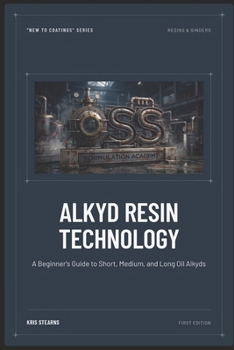
Alkyd Resin Technology: A Beginner's Guide to Short, Medium, and Long Oil Alkyds
No Customer Reviews

No goggles-and-Erlenmeyer-flask stuff here. Nobody in this industry is discovering new elements. If you've ever made a vinaigrette, you already understand more alkyd chemistry than you think: you're mixing a few known ingredients, in known ratios, under known conditions, to hit a target result. That's it. That's basically the whole job. An alkyd resin is what happens when you cook oil - yes, actual vegetable oil, the same family of stuff as your kitchen's soybean or linseed oil - together with some acids and alcohols, at high heat, until they chemically link up into one big molecule. That molecule becomes the backbone of a can of paint or varnish. ### The basic recipe, three ingredients Every alkyd, no matter how much oil is in it, is built from three families of raw material: 1. **A polyol** - a molecule with multiple "hooks" (alcohol/hydroxyl groups) for other things to attach to. Think glycerol (yes, the stuff in soap and lotion), or pentaerythritol, or trimethylolpropane. These are the scaffolding.
2. **A polybasic acid** - usually phthalic anhydride, sometimes isophthalic acid. This is the other half of the scaffolding, and it's what gives the resin its "backbone stiffness." More of this = harder, tougher resin.
3. **A fatty acid or oil** - soybean, linseed, coconut, tall oil, castor oil, and others. This is the flexible, film-forming part. Cook these together under heat, and the polyol and the acid link up (like Lego bricks snapping together) while the oil dangles off the sides. The result is a big, branched molecule - part rigid scaffold, part flexible oil tail - dissolved in solvent, ready to go into a can. ### "Oil length" - the single most important number in this entire book **Oil length** is just the percentage of the finished resin, by weight, that came from oil/fatty acid. That's it. No hidden meaning. - **Short oil**: less than 40% oil. Hard, glossy, usually needs to be baked with a partner resin to cure.
- **Medium oil**: roughly 40-60% oil. The "bridge" - air-dries on its own, with real hardness.
- **Long oil**: more than 60% oil. Very flexible, dries in air easily, classic old-school "paint that smells like a hardware store." A quick honest note before we go further: the industry has never fully agreed on the exact decimal points for these boundaries. You'll see short oil defined as under 40%, or under 45%, or even under 30% depending on the source. Same story at the top end - some sources put "long oil" above 55%, others above 60%, and some carve out a separate "very long oil" category above 70%. Don't lose sleep over the exact digits. What matters is the underlying idea: less oil pushes a resin toward hard, glossy, and bake-dependent; more oil pushes it toward soft, flexible, and self-curing in open air. This book walks through all three, in order, from least oil to most - short, medium, then long - so you can see exactly how that single sliding number reshapes everything about how a resin is made, modified, and used. Let's start at the hard, glossy end of the spectrum.
2. **A polybasic acid** - usually phthalic anhydride, sometimes isophthalic acid. This is the other half of the scaffolding, and it's what gives the resin its "backbone stiffness." More of this = harder, tougher resin.
3. **A fatty acid or oil** - soybean, linseed, coconut, tall oil, castor oil, and others. This is the flexible, film-forming part. Cook these together under heat, and the polyol and the acid link up (like Lego bricks snapping together) while the oil dangles off the sides. The result is a big, branched molecule - part rigid scaffold, part flexible oil tail - dissolved in solvent, ready to go into a can. ### "Oil length" - the single most important number in this entire book **Oil length** is just the percentage of the finished resin, by weight, that came from oil/fatty acid. That's it. No hidden meaning. - **Short oil**: less than 40% oil. Hard, glossy, usually needs to be baked with a partner resin to cure.
- **Medium oil**: roughly 40-60% oil. The "bridge" - air-dries on its own, with real hardness.
- **Long oil**: more than 60% oil. Very flexible, dries in air easily, classic old-school "paint that smells like a hardware store." A quick honest note before we go further: the industry has never fully agreed on the exact decimal points for these boundaries. You'll see short oil defined as under 40%, or under 45%, or even under 30% depending on the source. Same story at the top end - some sources put "long oil" above 55%, others above 60%, and some carve out a separate "very long oil" category above 70%. Don't lose sleep over the exact digits. What matters is the underlying idea: less oil pushes a resin toward hard, glossy, and bake-dependent; more oil pushes it toward soft, flexible, and self-curing in open air. This book walks through all three, in order, from least oil to most - short, medium, then long - so you can see exactly how that single sliding number reshapes everything about how a resin is made, modified, and used. Let's start at the hard, glossy end of the spectrum.
Format:Paperback
Language:English
ISBN:B0HDL415GS
ISBN13:9798191568317
Release Date:August 2026
Publisher:Independently Published
Length:46 Pages
Weight:0.17 lbs.
Dimensions:0.1" x 6.0" x 9.0"
Customer Reviews
0 rating
Copyright © 2026 Thriftbooks.com
Terms of Use | Privacy Policy | Do Not Sell/Share My Personal Information | Cookie Notice | Cookie Preferences | Accessibility Statement
ThriftBooks ® and the ThriftBooks ® logo are registered trademarks of Thrift Books Global, LLC
ThriftBooks ® and the ThriftBooks ® logo are registered trademarks of Thrift Books Global, LLC
