


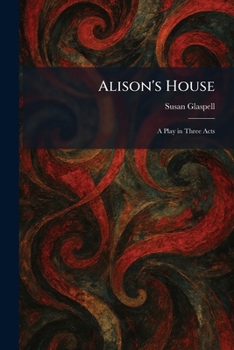
Alison's House: A Play in Three Acts

Select Format
Select Condition 
Book Overview
"Alison's House" is a poignant and powerful three-act play by the acclaimed dramatist Susan Glaspell. Set on the eve of the twentieth century in 1899, the story unfolds eighteen years after the death of the celebrated poet Alison Stanhope. As her surviving family members gather at her old homestead to prepare it for sale, they are forced to confront the secrets and sacrifices that defined Alison's life and work. The discovery of a hidden collection of poems brings a long-buried scandal to the surface, sparking a profound debate over whether a creator's private struggles belong to their family or to the world.
Inspired by the life and legacy of Emily Dickinson, this work explores themes of artistic integrity, family loyalty, and the shifting social mores of a changing era. Glaspell masterfully captures the tension between the Victorian past and the impending modern age, illustrating how the truth of a person's soul can survive through their art. A landmark of American theater, "Alison's House" earned the Pulitzer Prize for Drama in 1931 and remains a significant exploration of the female voice in literature. This play is an essential read for those interested in classic American drama, feminist literature, and the complex relationship between an artist's public image and private reality.
This work has been selected by scholars as being culturally important, and is part of the knowledge base of civilization as we know it. This work was reproduced from the original artifact, and remains as true to the original work as possible. Therefore, you may see the original copyright references, library stamps (as most of these works have been housed in our most important libraries around the world), and other notations in the work.
This work is in the public domain in the United States of America, and possibly other nations. Within the United States, you may freely copy and distribute this work, as no entity (individual or corporate) has a copyright on the body of the work.
As a reproduction of a historical artifact, this work may contain missing or blurred pages, poor pictures, errant marks, etc. Scholars believe, and we concur, that this work is important enough to be preserved, reproduced, and made generally available to the public. We appreciate your support of the preservation process, and thank you for being an important part of keeping this knowledge alive and relevant.
Related Subjects
DramaCustomer Reviews
ThriftBooks ® and the ThriftBooks ® logo are registered trademarks of Thrift Books Global, LLC
