


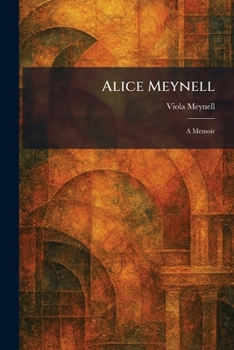
Alice Meynell: A Memoir

Select Format
Select Condition 
Book Overview
"Alice Meynell, a Memoir" offers an intimate and comprehensive look into the life of one of the late nineteenth and early twentieth centuries' most distinguished literary figures. Written by her daughter, Viola Meynell, this biography provides a unique perspective on the celebrated poet, essayist, and suffragist whose work garnered the admiration of contemporaries like John Ruskin and George Meredith. The memoir traces Alice Meynell's development as a writer and her central role in the literary and social circles of her day.
Through personal recollections and family insights, the work explores Meynell's creative process and the profound influence of her Catholic faith and social activism on her writing. It details her editorial work, her tireless advocacy for women's rights, and her deep connections with other prominent artists and intellectuals. This narrative not only illuminates the private life of a devoted mother and wife but also underscores her significance as a powerful voice in English literature. "Alice Meynell, a Memoir" remains an essential resource for those interested in the history of Victorian and Edwardian letters, offering a vivid portrait of a woman whose intellectual clarity and poetic precision left an indelible mark on her generation.
This work has been selected by scholars as being culturally important, and is part of the knowledge base of civilization as we know it. This work was reproduced from the original artifact, and remains as true to the original work as possible. Therefore, you may see the original copyright references, library stamps (as most of these works have been housed in our most important libraries around the world), and other notations in the work.
This work is in the public domain in the United States of America, and possibly other nations. Within the United States, you may freely copy and distribute this work, as no entity (individual or corporate) has a copyright on the body of the work.
As a reproduction of a historical artifact, this work may contain missing or blurred pages, poor pictures, errant marks, etc. Scholars believe, and we concur, that this work is important enough to be preserved, reproduced, and made generally available to the public. We appreciate your support of the preservation process, and thank you for being an important part of keeping this knowledge alive and relevant.
Customer Reviews
ThriftBooks® and the ThriftBooks® logo are registered trademarks of Thrift Books Global, LLC
