


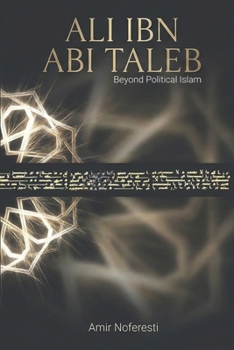
Ali ibn Abi Talib: Beyond Political Islam

Ali ibn Abi Talib: Beyond Political Islam
A Cross-Disciplinary Reference
For 1,400 years, Ali ibn Abi Talib, cousin and son-in-law of the Prophet Muhammad, fourth Rashidun Caliph, first Shīʿī Imam, has been weaponized.
Empires turned him into a partisan banner. The Safavids made him the dynastic god of Iranian state Shīʿism; the Ottomans branded his devotees as heretics.
Sects made him a battle line. His name became the fault line dividing Sunnī from Shīʿī, love from curse, brother from enemy.
Modern Islamists claim him as revolutionary ideologue. Both "Red Shīʿism" and Salafī vanguardism invoke Ali to sanctify political violence and totalitarian fusion of mosque and state.
But what if they've all misunderstood him?
The Hidden Truth Beneath the DistortionBeneath these imperial, sectarian, and ideological distortions lies a different Ali, one who refused to fracture the infant Ummah for a throne, who taught that people are "either your brothers in faith or equals in humanity," who distinguished spiritual guardianship (Wilāyah) from political power (Sultanate), who embodied justice (ʿadl) that transcended tribal loyalty.
This is the depoliticized Ali, the philosopher whose metaphysics rivals Ibn ʿArabī, the mystic whose heart Sufi orders call Qutb, the statesman whose letter to Malik al-Ashtar outshines Machiavelli, the sage whose wisdom resonates from Aristotle to Rumi to perennial philosophy.
But what if they all got him wrong?
This groundbreaking work deconstructs the politicized Ali forged by Ottoman-Safavid wars and recovers the original: a philosopher-sage whose wisdom transcends Islam itself.
Discover:
How 16th-century gunpowder empires created Sunni-Shia sectarianism (it's not what you think)
Ali's radical equality: "People are either your brothers in faith or equals in humanity"
Spiritual authority vs. political power: the metaphysics that heals division
Ali as universal archetype: compared to Aristotle, Stoics, Confucius, and modern virtue ethics
Why Ali rejected throne for unity: a blueprint against Political Islam
More than a biography. A reference arsenal:
Curated quotations by theme (justice, leadership, spirituality)
Comparative frameworks vs. Western philosophy
Historical timeline of depoliticization
Profund bibliography for scholars
Perfect for:
Islamic Studies scholars rethinking sectarian origins
Philosophy students discovering Islam's Aristotle
Interfaith leaders seeking Muslim unity resources
Spiritual seekers beyond dogma
Political theorists studying just governance
"A decolonial masterwork that returns Ali to his rightful place: not above sects, but beyond them."
In a world where Ali's name justifies militia violence from Lebanon to Yemen to Iraq, this book asks: What if the real Ali offers the antidote to the sectarianism done in his name?
Recovering Ali means more than Islamic reform, it means recognizing a seventh-century sage whose vision of justice, spiritual authority, and human equality speaks to anyone seeking wisdom beyond ideology.
"A groundbreaking reclamation of Ali ibn Abi Talib, not as sectarian symbol, but as universal Imam of Wisdom. Philosophically rigorous, historically meticulous, spiritually profound."
Customer Reviews
ThriftBooks ® and the ThriftBooks ® logo are registered trademarks of Thrift Books Global, LLC
