


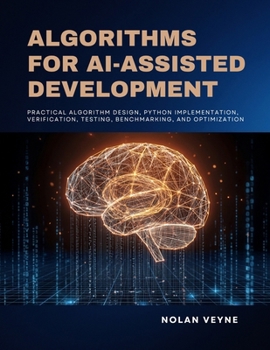
Algorithms for AI-Assisted Development: Practical Algorithm Design, Python Implementation, Verification, Testing, Benchmarking, and Optimization

AI can generate code in seconds. But can you prove that code is correct, efficient, scalable, and safe to trust?
AI-assisted development has changed programming forever. Writing code is faster and generating alternative solutions is easier. But a new engineering problem has emerged: plausible code is not necessarily correct code.
With AI assisted programming, you can ask an AI coding assistant to implement an algorithm, choose a data structure, optimize Python code, or propose another solution-and receive convincing code almost instantly. But does it satisfy the requirements? Is its complexity accurate? Will it survive edge cases and adversarial inputs? Will it perform at production scale?
These questions matter as AI software engineering moves into real development workflows.
Algorithms for AI-Assisted Development gives you the engineering discipline to answer them.
Nolan Veyne combines modern algorithm engineering with AI-assisted development, using Python as a practical laboratory. You'll learn to design, inspect, verify, test, benchmark, optimize, and validate algorithms instead of blindly accepting generated solutions.
Inside, you'll learn how to:
Turn ambiguous requirements into precise algorithm specifications.
Master practical algorithm complexity analysis, including time, space, worst-case, average-case, and amortized behavior.
Build a practical data structures Python foundation using lists, dictionaries, sets, queues, deques, trees, heaps, and graphs.
Strengthen algorithm design Python skills by connecting implementation decisions to correctness, complexity, memory, and scale.
Generate and compare multiple AI algorithm candidates instead of trusting the first plausible answer.
Apply AI code verification using contracts, invariants, induction, termination reasoning, assertions, and counterexamples.
Build rigorous algorithm testing workflows using boundary cases, adversarial inputs, differential testing, and metamorphic testing.
Apply property based testing Python techniques across automatically generated input spaces.
Use advanced strategies including greedy algorithms, dynamic programming, graph traversal, shortest paths, backtracking, and pruning.
Connect Big-O theory to measured performance through benchmarking, CPU and memory profiling, and empirical validation.
Apply Python performance optimization using evidence instead of intuition.
Engineer algorithms for production across memory, latency, throughput, numerical stability, hostile inputs, maintainability, and scale.
A Complete Human-AI Algorithm Engineering Workflow
Follow a practical lifecycle:
Specify → Design → Generate → Inspect → Verify → Test → Benchmark → Optimize → Validate
You'll learn where AI accelerates algorithm development-and where human engineering judgment must take control.
The book culminates in a production-oriented capstone that takes an AI-assisted algorithm from an imperfect requirement through competing designs, hidden-failure discovery, verification, testing, profiling, benchmarking, optimization, and production-readiness review.
AI can produce the implementation. Your advantage is knowing whether that implementation deserves to be trusted.
If you want to master modern algorithm engineering, strengthen your Python algorithm skills, and develop the verification, testing, performance, and reasoning abilities required for AI software engineering, get your copy of Algorithms for AI-Assisted Development and learn to engineer beyond the prompt.
Customer Reviews
ThriftBooks ® and the ThriftBooks ® logo are registered trademarks of Thrift Books Global, LLC
