


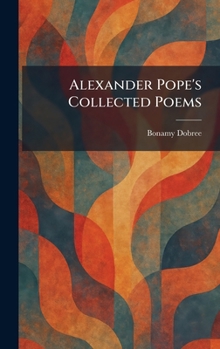
Alexander Pope's Collected Poems

Select Format
Select Condition 
Book Overview
"Alexander Pope's Collected Poems" brings together the masterful works of one of the most significant figures of the Augustan age. Known for his sharp wit, mastery of the heroic couplet, and incisive social satire, Pope remains a cornerstone of English literature. This collection encompasses the breadth of his poetic genius, from the playful mock-epic brilliance of "The Rape of the Lock" to the profound philosophical inquiries found in "An Essay on Man."
Pope's poetry is characterized by its technical precision, intellectual depth, and sophisticated use of irony. Readers will find his famous "An Essay on Criticism," which remains a foundational text in literary theory, alongside the biting critiques of "The Dunciad," where he skewers the literary landscape of his time. His work reflects the Neoclassical emphasis on order, reason, and the refinement of the English language.
This comprehensive gathering of his verses offers an essential look into the 18th-century literary mind. Whether engaging in political commentary or exploring the intricacies of human nature, Pope's technical brilliance and rhythmic elegance continue to resonate with modern audiences, securing his legacy as a premier satirist and poet.
This work has been selected by scholars as being culturally important, and is part of the knowledge base of civilization as we know it. This work was reproduced from the original artifact, and remains as true to the original work as possible. Therefore, you may see the original copyright references, library stamps (as most of these works have been housed in our most important libraries around the world), and other notations in the work.
This work is in the public domain in the United States of America, and possibly other nations. Within the United States, you may freely copy and distribute this work, as no entity (individual or corporate) has a copyright on the body of the work.
As a reproduction of a historical artifact, this work may contain missing or blurred pages, poor pictures, errant marks, etc. Scholars believe, and we concur, that this work is important enough to be preserved, reproduced, and made generally available to the public. We appreciate your support of the preservation process, and thank you for being an important part of keeping this knowledge alive and relevant.
Customer Reviews
ThriftBooks® and the ThriftBooks® logo are registered trademarks of Thrift Books Global, LLC
