


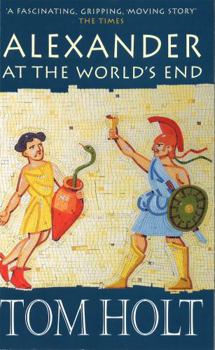
Alexander at World's End


Select Format
Select Condition 
Book Overview
'Wry and droll, fascinating and funny, by bringing us Alexander's nether parts this novel gives momentous matters unforgettable life' - Ross Leckie 'Witty, ironic ... and achieves a deeply felt authenticity' - NEW YORK TIMES
When his father dies, and he is reduced at a stroke from prosperity to penury, Euxenus decides to leave Athens and seek his fortune elsewhere. As a philosopher and intellectual of some note, he has no difficulty getting a job as tutor to a young prince in the wealthy but utterly provincial court of King Philip of Macedon. The young prince is called Alexander, and the rest is history. Or is it? Alexander conquered Greece, Egypt and the Persian Empire in the course of eight years, amassing a huge army along the way, and leaving behind him the foundations of countless new cities named after him. He proclaimed himself a deity, and died at the age of 33. In ALEXANDER AT THE WORLD'S END, Tom Holt tells the story of two remarkable men, one of whom conquered empires and one of whom struggled to overcome the drainage problems of a small village. It is a story of two men whose paths crossed only briefly, but whose encounter changed both their lives for ever. And it is a story which throws an extraordinary new light on the man who became Alexander the Great. Books by Tom Holt: Walled Orchard Series
Goatsong
The Walled Orchard J.W. Wells & Co. Series
The Portable Door
In Your Dreams
Earth, Air, Fire and Custard
You Don't Have to Be Evil to Work Here, But It Helps
The Better Mousetrap
May Contain Traces of Magic
Life, Liberty and the Pursuit of Sausages YouSpace Series
Doughnut
When It's A Jar
The Outsorcerer's Apprentice
The Good, the Bad and the Smug Novels
Expecting Someone Taller
Who's Afraid of Beowulf
Flying Dutch
Ye Gods
Overtime
Here Comes the Sun
Grailblazers
Faust Among Equals
Odds and Gods
Djinn Rummy
My Hero
Paint your Dragon
Open Sesame
Wish you Were Here
Alexander at World's End
Only Human
Snow White and the Seven Samurai
Olympiad
Valhalla
Nothing But Blue Skies
Falling Sideways
Little People
Song for Nero
Meadowland
Barking
Blonde Bombshell
The Management Style of the Supreme Beings
An Orc on the Wild Side
When his father dies, and he is reduced at a stroke from prosperity to penury, Euxenus decides to leave Athens and seek his fortune elsewhere. As a philosopher and intellectual of some note, he has no difficulty getting a job as tutor to a young prince in the wealthy but utterly provincial court of King Philip of Macedon. The young prince is called Alexander, and the rest is history. Or is it? Alexander conquered Greece, Egypt and the Persian Empire in the course of eight years, amassing a huge army along the way, and leaving behind him the foundations of countless new cities named after him. He proclaimed himself a deity, and died at the age of 33. In ALEXANDER AT THE WORLD'S END, Tom Holt tells the story of two remarkable men, one of whom conquered empires and one of whom struggled to overcome the drainage problems of a small village. It is a story of two men whose paths crossed only briefly, but whose encounter changed both their lives for ever. And it is a story which throws an extraordinary new light on the man who became Alexander the Great. Books by Tom Holt: Walled Orchard Series
Goatsong
The Walled Orchard J.W. Wells & Co. Series
The Portable Door
In Your Dreams
Earth, Air, Fire and Custard
You Don't Have to Be Evil to Work Here, But It Helps
The Better Mousetrap
May Contain Traces of Magic
Life, Liberty and the Pursuit of Sausages YouSpace Series
Doughnut
When It's A Jar
The Outsorcerer's Apprentice
The Good, the Bad and the Smug Novels
Expecting Someone Taller
Who's Afraid of Beowulf
Flying Dutch
Ye Gods
Overtime
Here Comes the Sun
Grailblazers
Faust Among Equals
Odds and Gods
Djinn Rummy
My Hero
Paint your Dragon
Open Sesame
Wish you Were Here
Alexander at World's End
Only Human
Snow White and the Seven Samurai
Olympiad
Valhalla
Nothing But Blue Skies
Falling Sideways
Little People
Song for Nero
Meadowland
Barking
Blonde Bombshell
The Management Style of the Supreme Beings
An Orc on the Wild Side
Format:Paperback
Language:English
ISBN:0349113157
ISBN13:9780349113159
Release Date:May 2000
Publisher:Abacus (UK)
Length:480 Pages
Weight:0.86 lbs.
Dimensions:1.3" x 5.0" x 7.5"
Related Subjects
Action & Adventure Asia Biographies Contemporary England Europe Fantasy Fiction Genre Fiction HistoricalCustomer Reviews
3 ratings
Foreshadowing Propaganda Imagery for USA Servitude Pledgers
Published by Thriftbooks.com User , 17 years ago
Is it 2009 or 1939? When I see a photograph of rows of clean-cut boys in warm green wool uniform standing attention in a grid, I can imagine a 70-years-later scene of American boys and girls promising to follow their new leader down the road of "hope and change". Little do they know that this ends in starvation, tears, and mud. The average German was going along to get along, just like most of us. The German worker of 1939 was facing a similar past 20 years as American workers of post-1973 who notice that their money buys less every month, if they have a job at all. NAZI's promised millions of new jobs (not "created or saved") and delivered, but making the tools of war not consumer or capital goods. The volume has top-quality photographs of the 1936-43 period as well as modern reproductions of preserved propaganda, but you can tell that 1944-45 were times of great shortage, and quality had dropped in the photographs. US photographers were well-equipped as the invasion progressed in 1945. Never since have photographers been allowed such candid access to actual events as in WWII. The whole 1982 Time-Life series of WWII from archives is hard to beat in terms of good professional imagery of the makings and effects of war. This volume focuses on the effects of privation on women/children/old people left back at home as the armed forces are fighting (and not swiftly winning) on several far-away fronts. The parallel with the USA of 2009 is that we civilians are not being destroyed by enemy bombs (our insurgent and guerrilla enemies don't have long-range bombers of a nation-state), but rather have been hollowed-out to a shell of an industrial nation (service economy), and saddled with 4x the Gross National Product as debt. Not so different than the economy of Germany of 1919, once the chickens come home to roost.
A sharp philosophical satire
Published by Thriftbooks.com User , 22 years ago
Alexander at the World's end pokes a very sharp satirical wit at ancient Greece, targeting, in particular, Athens, Alexander the Great and philosophy in a manner that is exhilarating.This is the story of Euxenus, whom we find reminiscing at the end of his life to Phryzeutzis about his life, his philosophy and the nature of fate.Euxenus was one of seven brothers who find themselves parentless in the Athenian democracy just after the expulsion of the Thirty Tyrants and coinciding with the birth of Alexander. Having each been farmed out to the worst teachers in their professions (in Euxenus' case to Diogenes the Yapping Dog philosopher) Euxenus finds himself on the wrong end of a white pebble, disinherited and starting his own successful DIY prophecy business. After nine years of moving up in the philosophy circles our erstwhile hero finds himself part of an Athenian delegation to Philip II of Macedon who has just seen fit to storm the city of Olynthus. A subsequent opportune meeting with the young Alexander and a delightful educational episode involving bees leads to his appointment as a tutor to the future military great. After his acceptance in the Macedonian military household we follow as the `Athenian wizard' and his snake in a jar (which Alexander makes come true) starts to educate the Macedonian prince and his entourage to open their minds. The irony is that, for a man who mocks Aristotle as much as Euxenus does (and the story of the mythical town at the end of the world ending in Aristotle's public humiliation is hilarious) his logic is remarkably peripatetic.By mid-book, Euxenus finds himself on the receiving end of olive stones fate as Philip orders him to be the oceia (founder) of the new colony of Olbia on the Black Sea. Setting off with his new and angry wife, Theano they arrive at the intended site and Euxenus is forced to experience the administrative problems of leading a group settling on land near an annoyed Scythian tribe with all its tribulations. Inadvertent raids, a suspected affair between wife and merchant-friend Tyrsenius and getting the colony up and running take us through the next ten years as his son grows alongside our erstwhile hero. Meanwhile, Philip II dies after Charonea and Alexander assumes the throne. Eventually they manage to self-produce their own alcohol thus giving them a good reason to name their city officially - Antolbia. During the celebration an open city gate allows a band of Scythians to storm the city, killing many founders and Euxenus' son. The repercussions are enormous as Theano leaves and the Antolbians finally destroy the neighbouring village. Euxenus leaves for Athens and on his arrival back home learns of the sack and destruction of Antolbia.After attempting to become the perfect farmer he suddenly finds himself on the receiving end of orders from Alexander to be the oceist for the city of Sogdania and during his trip to the city comes across his surviving brother Eudaemon, breaking his leg in
Fine Historical Fiction, Sadly Funny
Published by Thriftbooks.com User , 23 years ago
Alexander at the World's End is the nostalgic biography of Alexander the Great, as described by someone who had been a minor character but a constant observer in Alexander's life. As in Olympiad and The Walled Orchard, Holt writes in a first person voice which tells history as a real life but whose tone and character makes the history immediate. You don't need to know anything about Alexander, it'll teach what little you need to know and make you want to know much more about the characters it portrays. This book is written from the end of a life, about a man who died young and those who lived after. It is nostalgic, but wonderfully funny.
Copyright © 2026 Thriftbooks.com
Terms of Use | Privacy Policy | Do Not Sell/Share My Personal Information | Cookie Notice | Cookie Preferences | Accessibility Statement
ThriftBooks ® and the ThriftBooks ® logo are registered trademarks of Thrift Books Global, LLC
ThriftBooks ® and the ThriftBooks ® logo are registered trademarks of Thrift Books Global, LLC
