


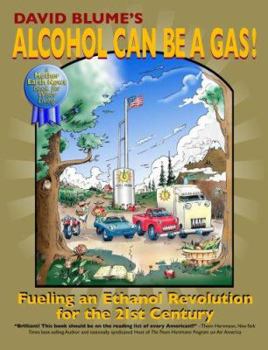
Alcohol Can Be a Gas!: Fueling an Ethanol Revolution for the 21st Century

Select Format
Select Condition 
Book Overview
For the last century it has been impossible to find reliable information on alcohol fuel production and use. Oil companies have continuously suppressed data on Henry Ford's favorite auto fuel. For... This description may be from another edition of this product.
Format:Hardcover
Language:English
ISBN:0979043786
ISBN13:9780979043789
Release Date:November 2007
Publisher:Intl Inst for Ecological Agric
Length:595 Pages
Weight:4.40 lbs.
Dimensions:11.0" x 1.8" x 8.5"
Customer Reviews
4 ratings
David Blume's ideas should be taken seriously and explored further
Published by Thriftbooks.com User , 17 years ago
I have David Blume's book Alcohol Can Be a Gas! and have read the book. I have a Bachelor's Degree with Honors in Physics, and a graduate degree in Engineering from U. of Ill. at Urbana-Champaign. The book is extensive, detailed and generally appears to be quite authoritative. Mr. Blume has about 30 years of experience in this field and knew Buckminster Fuller, who wrote the Foreword for the book. Blume makes a very credible case for the widespread use of ethanol in the U.S. starting essentially now, without waiting for further developments like cellulosic ethanol. This could allow for a "democratization of fuel production," rather than control by a few mega-businesses. Blume believes the current vehicle fleet needs little or only minor modifications to run on high concentrations of ethanol right now. I believe his contention that the petroleum industry is spreading misinformation to discredit ethanol as a viable current fuel option is credible. According to Blume the U.S. and the world are not even close to being "maxed out" in terms of capacity for renewably producing ethanol. But Blume also emphasizes the need for conservation. His ideas regarding the large-scale viability of ethanol derived from sugar cane to improve global warming are similar to those espoused by the British billionaire Richard Branson, founder of Virgin Group (see Tropical Bonanza, p. 41; according to Blume we don't have to cut down rainforest). He also describes numerous other feedstock crops that could be grown using renewable permaculture (rather than non renewable monoculture) techniques that are viable for large-scale ethanol production. A few examples are beets, sweet sorghum and non-traditional crops such as cattails (along roads and in planned wastewater treatment marshes), mesquite and buffalo gourd (cultivated in arid areas) and kelp farms (in coastal ocean areas such as coastal "deadzones"). Many may consider Blume's approach to be too simplistic and too "low tech" to be significant. "The market," they may say, "would have already embraced this approach if it was practical." But I think such a perspective is itself simplistic. Many people are now realizing the limitations of this perspective and realizing there are no real "pure markets." We live in a culture overly enamored with high technology; I see this constantly in medical practice (I am also a medical doctor). High technology is not always the best solution and such approaches frequently reflect a cultural bias toward techno-capitalism, rather than scientific or technical feasibility per se. We may, unfortunately, have to learn this the hard way. As the late libertarian economist Milton Friedman said, "Institutions don't learn, only people learn." David Blume's ideas should definitely be taken seriously and explored further.
THE Book to D.I.Y. or Smarten Up.
Published by Thriftbooks.com User , 18 years ago
NOTE: I wrote this review in 2007, just after getting the book. I said I didn't work for the author, etc., and that was quite true...until recently. Now, in 2009, I've recently gotten a job with the author's company, helping people put ethanol conversion kits in their vehicles. It would not be honest to fail to note that fact, so there's your update. Here is the original review. I have not edited anything from its original wording. This book showed me EXACTLY WHAT TO DO. Let me start by saying that I don't work for the author, he doesn't work for me, he doesn't owe me any money, and I haven't invested in any of his companies. Onward: this book shows you exactly how to produce your own ethanol or buy it at the pump and switch your vehicles from OIL..also known as gasoline. After reading the book, I know how to make ethanol on a farm...and NOT FROM CORN... but I learned how to make ethanol right in the city. I found that the book shows you how ethanol can make you money in a business or save you money when you just put it in your tank. I guess if you just want to read about the topic, this is the definitive reference book on the subject. The book has, uh, let's see: history, politics, business models, business strategies, agricultural analysis, agricultural advice and techniques, engineering, design, strategies for succeeding with zoning and permits, environmental analyses galore, and everything you could possibly want to know on the topic. I mainly stuck to the D.I.Y. stuff, but his documentation is superb and overwhelming on all those other topics. As to the vehicle conversions, I speak as an ASE-Certified mechanic and one who has a college education IN Auto Repair, and I can say that the instruction in this book is superb. For example, it's a thousand times easier to understand than "Auto Repair For Dummies". This book could save our once-proud but ever-weakening country. I urge you to get the book, read the book, and use the knowledge it will give you. Remember, the day may soon come when ethanol fuel is the only choice you have. What will you do if the book is out of print? You can make things better for yourself with this book immediately, but I also recommend that everyone should have this book on the shelf and at the ready, in case that day comes.
Matthew Stein, Author of When Technology Fails, BSME MIT
Published by Thriftbooks.com User , 18 years ago
I am an MIT engineer (BSME MIT, 1978) and Author of When Technology Fails, and I highly recommend this book. David Blume's opus, Alcohol Can Be a Gas, is the definitive guide to weaning America from the oil habit via biofuels. In great detail, it thoroughly debunks the myth that ethanol production takes nearly as much energy to run the process as it produces (corn does, but there are other alternatives to corn based ethanol), and shows how America can thrive by sustainably growing both an abundant food supply and biofuels at the same time (they can actually feed each other synergistically!). Blume shows us the pathway to personal and national energy independence! David Blume has been an alcohol pioneer since Buckminster Fuller, one of America's foremost visionary geniuses, coached and coaxed Blume in the 70's to continue to pursue their united dream of energy independence through biofuels. Blume is a hands-on kind of guy, having been an organic farmer, inventor, permaculture teacher and alcohol pioneer over the past thirty years. This book is encyclopedic in scope, and is for everyone from policy makers to consumers to the back yard tinker who wishes to make his own ethanol and convert his existing gasoline powered car to run on ethanol fuel Highly recommended!
One of the Most Important Books I've Read
Published by Thriftbooks.com User , 18 years ago
This book gives me hope that not only can we survive the coming troubles (Peak Oil, climate change, pollution, corporate globalism), we can actually make the Earth into a really nice place to live. There is so much good plain common sense in this book, mixed with visionary genius, plus very detailed instructions, for breaking free of the need for gasoline. It is a blueprint for taking control of our energy future. It describes how combining sustainable agriculture and alcohol fuel production can solve most of the Earth's most pressing problems in elegant, simple ways, starting with you and me and our family and neighbors. And the author is no Pollyanna - he looks all the problems square in the face and shows what we can do. He answers all the myths about ethanol (which are fueled by oil companies), and, as far as I'm concerned, exposes and explodes them. The book has over 400 footnotes and is the most credible thing I've seen in ages.
Copyright © 2026 Thriftbooks.com Terms of Use
| Privacy Policy | Do Not
Sell/Share My Personal Information | Cookie Policy | Cookie Preferences | Accessibility Statement
ThriftBooks® and the ThriftBooks® logo are registered trademarks of Thrift Books Global, LLC
ThriftBooks® and the ThriftBooks® logo are registered trademarks of Thrift Books Global, LLC
