


All Formats & Editions

Alarms and Discursions
If Mr. Chesterton had been permitted to have his own way this handful of papers would have been sent out under the title of "Gargoyles." Perhaps the publisher foresaw horror upon the faces of really unimaginative readers when once brought face to face with a "monster" title;...

Alarms And Discursions
Alarms and Discursions (Annotated)
Gilbert Keith Chesterton was an influential English writer of the early 20th century. His prolific and diverse output included journalism, philosophy, poetry, biography, Christian apologetics, fantasy, and detective fiction. Chesterton has been called the "prince of paradox."...
Alarms and Discursions
Alarms and Discursions
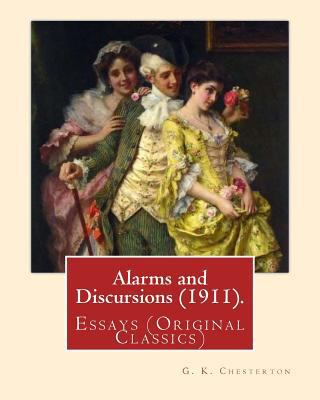
Alarms and Discursions (1911). By: G. K. Cheste...
Essays reprinted from the Daily News. Includes "On Gargoyles," "The Futurists," "How I Found the Superman," and "Cheese."...... Gilbert Keith Chesterton, KC*SG (29 May 1874 - 14 June 1936), better known as G. K. Chesterton, was an English writer, poet, philosopher, dramatist,...
Alarms and discursions. By: G. K. Chesterton (O...
Alarms and Discursions
Alarms And Discursions
Now this priest was told by his people to build a great tower, pointing to the sky in salutation of the Sun-god; and he pondered long and heavily before he picked his materials. For he was resolved to use nothing that was not almost as clear and exquisite as sunshine itself;...
Alarms and Discursions
But about this time the island was caught in a swarm of pirates; and the shepherds hadto turn themselves into rude warriors and seamen; and at first they were utterly brokendown in blood and shame; and the pirates might have taken the jewel flung up for everfrom their sacred...
Alarms and Discursions (Esprios Classics)
Gilbert Keith Chesterton (29 May 1874 - 14 June 1936) was an English writer, philosopher, lay theologian, and literary and art critic. He has been referred to as the "prince of paradox". Time magazine observed of his writing style: "Whenever possible Chesterton made his points...
Alarms and Discursions: Explorations of Art, So...
"Alarms and Discursions" by G. K. Chesterton is a collection of essays that delve into various aspects of art, society, and human nature. The book opens with a reflection on the grotesque in art, using the imagery of gargoyles to explore the evolution of artistic expression from...
Alarms and Discursions
Chesterton has been called the "prince of paradox" and Alarms and Discursions is a collections of short stories and essays where you will find his contradictory imagination flowing very well in some stories.
Alarms and Discursions
This collection of literature attempts to compile many of the classic, timeless works that have stood the test of time and offer them at a reduced, affordable price, in an attractive volume so that everyone can enjoy them.
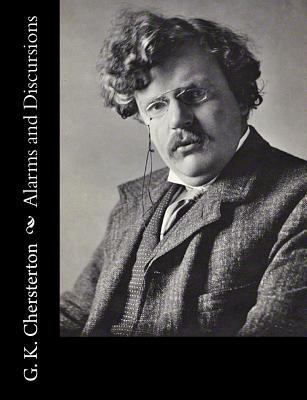
Alarms and Discursions
Alarms and Discursions

Alarms and discursions,
Alarms and Discursions
A collection of essays and musings by one of the most prolific and witty writers of the early 20th century. Chesterton's writing ranges from the profound to the whimsical, and his unique perspective on the world is sure to delight and entertain readers of all ages. This...
Alarms and Discursions
A collection of essays and musings by one of the most prolific and witty writers of the early 20th century. Chesterton's writing ranges from the profound to the whimsical, and his unique perspective on the world is sure to delight and entertain readers of all ages. This...
Alarms and Discursions
This work has been selected by scholars as being culturally important, and is part of the knowledge base of civilization as we know it. This work was reproduced from the original artifact, and remains as true to the original work as possible. Therefore, you will see the original...
Alarms And Discursions
Alarms and Discursions
Alarms and Discursions
Gilbert Keith Chesterton, KC (29 May 1874 - 14 June 1936), was an English writer, poet, philosopher, dramatist, journalist, orator, lay theologian, biographer, and literary and art critic. Chesterton is often referred to as the "prince of paradox". Time magazine has observed...
Alarms and Discursions
Alarms And Discursions
A happy and innocent people who were primarily shepherds and farmers formerly resided on an island. Not in an idolatrous manner, but rather as the golden crown of the deity that all such children perceive almost as clearly as the sun, they worshipped the sun. They devised a beautiful...
Alarms and Discursions
Once upon a time there lived upon an island a merry and innocent people, mostly shepherds and tillers of the earth. They were republicans, like all primitive and simple souls; they talked over their affairs under a tree, and the nearest approach they had to a personal ruler was...
ThriftBooks ® and the ThriftBooks ® logo are registered trademarks of Thrift Books Global, LLC
