


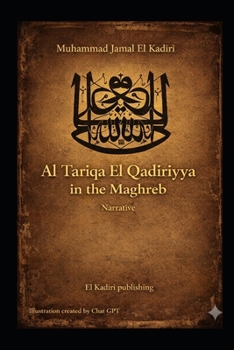
Al Qadiriyya Sufi Order in the Maghreb: An Epic without glorification. Narrative
No Customer Reviews

Foreword The writing of this manuscript was virtually entrusted to a scribe attached to the saintly Sidi Abdelhafidh El Qadiri. This discreet taleb brings with him:
- Fidelity (El Wafā): he is not an external observer. He is Abdelhafidh's shadow. His account is not a report, but a testimony of devotion.
- The Sacred Nature of the pen (Qalam): for a scribe, writing is a quasi-religious act. Every weighed word must be worthy of the lineage.
He is:
- The itinerant eyewitness: by having him travel from Baghdad to Sakia El Hamra and Oued Ed-Dhahab, and then accompany the return journey towards the Hodna, I granted him full geographical legitimacy. He lived exile, scattered the esoteric teaching of the Tariqa Al Qadiriyya to the four winds, and endured the harsh return eastward after the oppression of the Iberian colonizers.
- The "Mirror" of Abdelhafidh: because he is deliberately effaced, he occupies only a modest place. He leaves all the light to the Master. He is the one who listens to his nocturnal confidences, prepares the ink, and captures his silences between sermons.
- The archivist of memory: he fully justifies his determination to transmit, so that dust may not gather on his scribe's desk in the attic of our house. It is he who saved the Sajara from oblivion. His defining psychological traits are:
- Humility: he might begin by saying that he is but an instrument, a simple qalam in the hands of destiny.
- Physical fatigue that does not impair mental clarity: the return to the Hodna marks the end of a cycle. He writes at the close of his life, sensing the urgency of fixing memories in words.
- His language: unlike the perhaps more procedural style of Tchalabi, the narrator of the novelistic saga Tin-n-Ouahr, the taleb may employ a more poetic prose, El Melhoun; interwoven with Sufi references or esoteric metaphors linked to the desert, assistance to the poor, and the quest for knowledge.
Important note of the author
By an unalterable principle, the El Qadiriyya brotherhood is not a sect, notwithstanding the claims of certain advocates of rigid secularism. It does not keep membership lists, nor does it gather its followers in order to conspire against anyone. It offers allegiance to no political system. Those who claim that it teaches blind obedience to authority are lying. It simply rejects anarchy, which too often serves the "happiness" of a certain form of authoritarianism - alas latent in countries constrained by neo-colonialism.
By contrast, certain modern "circles" claiming affiliation with it, under the pretext of historical anchorage and while promoting elitism, tend rather to glorify sultans and ostentatiously associate themselves with the powerful of this world.
Those who seek, rightly or wrongly, a genuine filiation with the Prince of Saints must first compare their DNA with that of the inhabitants of Jilan, the beautiful and prosperous region of Ancient Persia where this prodigious preacher was born - a man who aided people in material and spiritual need, and who hoped that no human precarity would remain on Planet Earth.
To conclude this modest introduction to the El Qadiriyya brotherhood, from which I have The distinguished honor of descending, I hold that the only form of paternity worth seeking among the learned Sufis of yesterday, today, or tomorrow is... purely spiritual.
Finally, it is essential to state that any resemblance, foreign or otherwise, to persons living or deceased in the text of this narrative is purely coincidental and cannot, therefore, give rise to any ambiguity. Dedication To all the Tolbas of the Maghreb, walking on foot with the caravans, in the wake of Abdoul Qadir Al Jilani, the Prince of Saints, in order to spread the esoteric teachings of Al Tariqa Al Qadiriyya
- Fidelity (El Wafā): he is not an external observer. He is Abdelhafidh's shadow. His account is not a report, but a testimony of devotion.
- The Sacred Nature of the pen (Qalam): for a scribe, writing is a quasi-religious act. Every weighed word must be worthy of the lineage.
He is:
- The itinerant eyewitness: by having him travel from Baghdad to Sakia El Hamra and Oued Ed-Dhahab, and then accompany the return journey towards the Hodna, I granted him full geographical legitimacy. He lived exile, scattered the esoteric teaching of the Tariqa Al Qadiriyya to the four winds, and endured the harsh return eastward after the oppression of the Iberian colonizers.
- The "Mirror" of Abdelhafidh: because he is deliberately effaced, he occupies only a modest place. He leaves all the light to the Master. He is the one who listens to his nocturnal confidences, prepares the ink, and captures his silences between sermons.
- The archivist of memory: he fully justifies his determination to transmit, so that dust may not gather on his scribe's desk in the attic of our house. It is he who saved the Sajara from oblivion. His defining psychological traits are:
- Humility: he might begin by saying that he is but an instrument, a simple qalam in the hands of destiny.
- Physical fatigue that does not impair mental clarity: the return to the Hodna marks the end of a cycle. He writes at the close of his life, sensing the urgency of fixing memories in words.
- His language: unlike the perhaps more procedural style of Tchalabi, the narrator of the novelistic saga Tin-n-Ouahr, the taleb may employ a more poetic prose, El Melhoun; interwoven with Sufi references or esoteric metaphors linked to the desert, assistance to the poor, and the quest for knowledge.
Important note of the author
By an unalterable principle, the El Qadiriyya brotherhood is not a sect, notwithstanding the claims of certain advocates of rigid secularism. It does not keep membership lists, nor does it gather its followers in order to conspire against anyone. It offers allegiance to no political system. Those who claim that it teaches blind obedience to authority are lying. It simply rejects anarchy, which too often serves the "happiness" of a certain form of authoritarianism - alas latent in countries constrained by neo-colonialism.
By contrast, certain modern "circles" claiming affiliation with it, under the pretext of historical anchorage and while promoting elitism, tend rather to glorify sultans and ostentatiously associate themselves with the powerful of this world.
Those who seek, rightly or wrongly, a genuine filiation with the Prince of Saints must first compare their DNA with that of the inhabitants of Jilan, the beautiful and prosperous region of Ancient Persia where this prodigious preacher was born - a man who aided people in material and spiritual need, and who hoped that no human precarity would remain on Planet Earth.
To conclude this modest introduction to the El Qadiriyya brotherhood, from which I have The distinguished honor of descending, I hold that the only form of paternity worth seeking among the learned Sufis of yesterday, today, or tomorrow is... purely spiritual.
Finally, it is essential to state that any resemblance, foreign or otherwise, to persons living or deceased in the text of this narrative is purely coincidental and cannot, therefore, give rise to any ambiguity. Dedication To all the Tolbas of the Maghreb, walking on foot with the caravans, in the wake of Abdoul Qadir Al Jilani, the Prince of Saints, in order to spread the esoteric teachings of Al Tariqa Al Qadiriyya
Format:Paperback
Language:English
ISBN:B0GK18J1Y8
ISBN13:9798245745909
Release Date:January 2026
Publisher:Independently Published
Length:104 Pages
Weight:0.33 lbs.
Dimensions:0.2" x 6.0" x 9.0"
Customer Reviews
0 rating
Copyright © 2026 Thriftbooks.com Terms of Use
| Privacy Policy | Do Not
Sell/Share My Personal Information | Cookie Policy | Cookie Preferences | Accessibility Statement
ThriftBooks® and the ThriftBooks® logo are registered trademarks of Thrift Books Global, LLC
ThriftBooks® and the ThriftBooks® logo are registered trademarks of Thrift Books Global, LLC
