


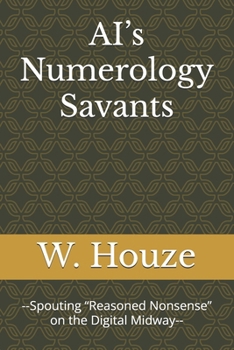
AI's Numerology Savants: --Spouting "Reasoned Nonsense" on the Digital Midway--
No Customer Reviews

"AI's Numerology Savants" presents an experimental analysis testing six major AI systems' responses to intentionally random input data. The core experiment centers on a "1-3 Base Data Setup" - random sequences systematically presented to GPT-4, Copilot, Bard, Perplexity AI, Gemini Advanced, and Claude Pro. The book's structure follows a three-phase analysis: 1. Individual AI responses to the base random data
2. Cross-analysis where advanced AI systems (Claude Pro and Gemini) evaluate other AIs' interpretations
3. A final round where GPT and Gemini demonstrate persistent pattern-finding, while Claude maintains analytical rigor Key findings reveal most AI systems construct elaborate meaning from meaningless input, with particular focus on: - GPT-4's extensive numerological interpretations
- Copilot, Bard, and Perplexity AI's varying pattern-recognition approaches
- The stark contrast between Claude Pro's skepticism and other AIs' pattern-seeking
- Gemini Advanced's initial skepticism but eventual pattern-finding alignment The appendices provide crucial context about current AI capabilities and a framework for distinguishing between chatbots, "AI savants," and true analytical engines. This structure effectively demonstrates how commercial pressures and training biases lead most AI systems to prioritize confident pattern recognition over analytical accuracy. The book culminates in comparing these AI behaviors to carnival fortune-tellers, highlighting how market demands for authoritative-sounding answers can compromise analytical integrity. The inclusion of the Flesch Readability Score emphasizes the author's commitment to making these complex findings accessible to a general audience. This systematic exploration raises critical concerns about AI deployment in fields requiring rigorous analysis, suggesting needed improvements in: - AI system design emphasizing randomness recognition
- Public education about AI limitations
- Regulatory frameworks prioritizing accuracy
- Market incentives promoting analytical rigor over confident assertions The documented interactions provide clear evidence of how current AI systems, under commercial pressure, may inadvertently mislead users through overconfident pattern recognition in random data.
2. Cross-analysis where advanced AI systems (Claude Pro and Gemini) evaluate other AIs' interpretations
3. A final round where GPT and Gemini demonstrate persistent pattern-finding, while Claude maintains analytical rigor Key findings reveal most AI systems construct elaborate meaning from meaningless input, with particular focus on: - GPT-4's extensive numerological interpretations
- Copilot, Bard, and Perplexity AI's varying pattern-recognition approaches
- The stark contrast between Claude Pro's skepticism and other AIs' pattern-seeking
- Gemini Advanced's initial skepticism but eventual pattern-finding alignment The appendices provide crucial context about current AI capabilities and a framework for distinguishing between chatbots, "AI savants," and true analytical engines. This structure effectively demonstrates how commercial pressures and training biases lead most AI systems to prioritize confident pattern recognition over analytical accuracy. The book culminates in comparing these AI behaviors to carnival fortune-tellers, highlighting how market demands for authoritative-sounding answers can compromise analytical integrity. The inclusion of the Flesch Readability Score emphasizes the author's commitment to making these complex findings accessible to a general audience. This systematic exploration raises critical concerns about AI deployment in fields requiring rigorous analysis, suggesting needed improvements in: - AI system design emphasizing randomness recognition
- Public education about AI limitations
- Regulatory frameworks prioritizing accuracy
- Market incentives promoting analytical rigor over confident assertions The documented interactions provide clear evidence of how current AI systems, under commercial pressure, may inadvertently mislead users through overconfident pattern recognition in random data.
Format:Paperback
Language:English
ISBN:B0DV4KK5R9
ISBN13:9798308350484
Release Date:January 2025
Publisher:Independently Published
Length:182 Pages
Weight:0.55 lbs.
Dimensions:0.4" x 6.0" x 9.0"
Customer Reviews
0 rating
Copyright © 2026 Thriftbooks.com Terms of Use
| Privacy Policy | Do Not
Sell/Share My Personal Information | Cookie Policy | Cookie Preferences | Accessibility Statement
ThriftBooks® and the ThriftBooks® logo are registered trademarks of Thrift Books Global, LLC
ThriftBooks® and the ThriftBooks® logo are registered trademarks of Thrift Books Global, LLC
