


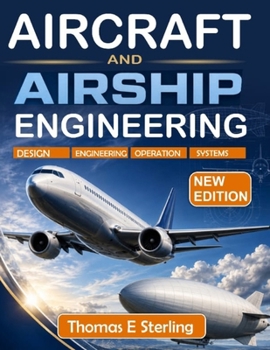
Aircraft and Airship Engineering: Aerodynamics, Structures, Stability, Propulsion, and Modern Design Methods
No Customer Reviews

Aircraft and airships are built through many connected decisions. Yet aerodynamics, performance, structures, propulsion, stability, control, materials, and systems are often studied as separate subjects. This can make it difficult to understand how a change in one area affects the complete flight vehicle.
This book brings those subjects together in one clear engineering reference. It explains the principles of heavier-than-air and lighter-than-air flight, then shows how they guide mission definition, configuration, sizing, analysis, system integration, manufacturing, testing, certification, and operation.
Organized across eighteen chapters and six technical appendices, the material progresses from the atmosphere and basic flight physics to complete aircraft and airship design studies. Equations, diagrams, comparison figures, tables, worked relationships, and design data support classroom learning, self-study, and engineering project work.Understand how atmospheric conditions influence lift, drag, engine output, structural loading, and buoyancy.Compare aircraft and airships through their lifting methods, performance strengths, operating limits, and design needs.Follow the path from mission requirements and configuration selection to preliminary sizing and integrated design.Study structures, loads, weight, balance, materials, propulsion, control, avionics, and support systems as connected parts of one vehicle.Examine airship aerostatics, lifting gases, envelope design, propulsion integration, trim, mooring, ground handling, and operations.Connect established methods with computer analysis, testing, certification, electric and hybrid flight, cleaner propulsion, autonomous systems, and advanced manufacturing.Use final design studies and reference appendices to reinforce technical review and practical application.Major topics include atmospheric conditions, fluid flow, lift and drag, airfoils and wings, flight mechanics, performance, stability and control, aircraft configuration, structural loads, materials, propulsion, onboard systems, buoyancy, lifting gases, ballonets, envelope and gondola design, mooring, ground handling, weight and balance, manufacturing, flight testing, certification, computer-based analysis, and emerging flight technologies. The book is suited to undergraduate and graduate students, instructors, aerospace and mechanical engineering readers, aircraft and airship designers, researchers, pilots, aviation professionals, and independent learners who want a broad but organized understanding of flight-vehicle development. It is especially useful for readers who want aircraft and airship subjects presented together within one practical source. Build a clearer understanding of how complete flight vehicles are conceived, analysed, tested, and improved. Add this engineering reference to your library and begin connecting the principles, systems, and design decisions that shape aircraft and airships.
This book brings those subjects together in one clear engineering reference. It explains the principles of heavier-than-air and lighter-than-air flight, then shows how they guide mission definition, configuration, sizing, analysis, system integration, manufacturing, testing, certification, and operation.
Organized across eighteen chapters and six technical appendices, the material progresses from the atmosphere and basic flight physics to complete aircraft and airship design studies. Equations, diagrams, comparison figures, tables, worked relationships, and design data support classroom learning, self-study, and engineering project work.Understand how atmospheric conditions influence lift, drag, engine output, structural loading, and buoyancy.Compare aircraft and airships through their lifting methods, performance strengths, operating limits, and design needs.Follow the path from mission requirements and configuration selection to preliminary sizing and integrated design.Study structures, loads, weight, balance, materials, propulsion, control, avionics, and support systems as connected parts of one vehicle.Examine airship aerostatics, lifting gases, envelope design, propulsion integration, trim, mooring, ground handling, and operations.Connect established methods with computer analysis, testing, certification, electric and hybrid flight, cleaner propulsion, autonomous systems, and advanced manufacturing.Use final design studies and reference appendices to reinforce technical review and practical application.Major topics include atmospheric conditions, fluid flow, lift and drag, airfoils and wings, flight mechanics, performance, stability and control, aircraft configuration, structural loads, materials, propulsion, onboard systems, buoyancy, lifting gases, ballonets, envelope and gondola design, mooring, ground handling, weight and balance, manufacturing, flight testing, certification, computer-based analysis, and emerging flight technologies. The book is suited to undergraduate and graduate students, instructors, aerospace and mechanical engineering readers, aircraft and airship designers, researchers, pilots, aviation professionals, and independent learners who want a broad but organized understanding of flight-vehicle development. It is especially useful for readers who want aircraft and airship subjects presented together within one practical source. Build a clearer understanding of how complete flight vehicles are conceived, analysed, tested, and improved. Add this engineering reference to your library and begin connecting the principles, systems, and design decisions that shape aircraft and airships.
Format:Paperback
Language:English
ISBN:B0HC5VS4W5
ISBN13:9798189831577
Release Date:July 2026
Publisher:Independently Published
Length:424 Pages
Weight:2.15 lbs.
Dimensions:0.9" x 8.5" x 11.0"
Related Subjects
Engineering Science Science & Math Science & Scientists Science & Technology TechnologyCustomer Reviews
0 rating
Copyright © 2026 Thriftbooks.com
Terms of Use | Privacy Policy | Do Not Sell/Share My Personal Information | Cookie Notice | Cookie Preferences | Accessibility Statement
ThriftBooks ® and the ThriftBooks ® logo are registered trademarks of Thrift Books Global, LLC
ThriftBooks ® and the ThriftBooks ® logo are registered trademarks of Thrift Books Global, LLC
