


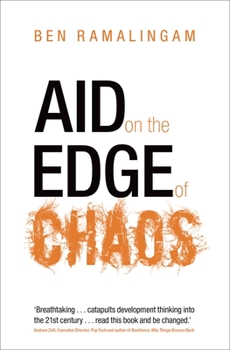
Aid on the Edge of Chaos: Rethinking International Cooperation in a Complex World
No Customer Reviews

Select Format
Select Condition 
Book Overview
It is widely recognised that the foreign aid system - of which every country in the world is a part - is in need of drastic overhaul. There are conflicting opinions as to what should be done. Some call for dramatic increases to achieve longstanding promises. Others bang the drum for cutting it altogether, and suggest putting the fate of poor and vulnerable people in the hands of markets or business. A few argue that what is needed is creative, innovative transformation. The arguments in Aid on the Edge of Chaos are firmly in the third of these categories. In this ground-breaking book, Ben Ramalingam shows that the linear, mechanistic models and assumptions that foreign aid is built on are more at home in early twentieth century industry than in the dynamic, complex world we face today. The reality is that economies and societies are less like machines and more like ecosystems. Aid on the Edge of Chaos explores how thinkers and practitioners in economics, business, and public policy have started to embrace new, ecologically literate approaches to thinking and acting, informed by the ideas of complex adaptive systems research. It showcases insights, experiences, and dramatic results of a growing network of practitioners, researchers, and policy makers who are applying a complexity-informed approach to aid challenges. From transforming approaches to child malnutrition, to rethinking process of macroeconomic growth, from rural Vietnam to urban Columbia, Aid on the Edge of Chaos shows how embracing the ideas of complex systems thinking can help make foreign aid more relevant, more appropriate, more innovative, and more catalytic. It argues that taking on these ideas will be a vital part of the transformation of aid, from a post-WW2 mechanism of resource transfer, to a truly innovative and dynamic form of global cooperation fit for the twenty-first century.
Format:Hardcover
Language:English
ISBN:0199578028
ISBN13:9780199578023
Release Date:January 2014
Publisher:Oxford University Press
Length:472 Pages
Weight:1.89 lbs.
Dimensions:1.4" x 6.3" x 9.3"
Customer Reviews
0 rating
Copyright © 2026 Thriftbooks.com
Terms of Use | Privacy Policy | Do Not Sell/Share My Personal Information | Cookie Policy | Cookie Preferences | Accessibility Statement
ThriftBooks ® and the ThriftBooks ® logo are registered trademarks of Thrift Books Global, LLC
ThriftBooks ® and the ThriftBooks ® logo are registered trademarks of Thrift Books Global, LLC
