


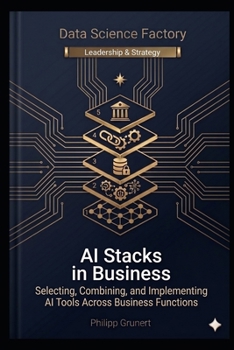
AI Stacks in Business: Selecting, Combining, and Implementing AI Tools Across Business Functions

Many companies are experimenting with AI tools. Far fewer are building AI stacks that actually work in day-to-day business.
Artificial intelligence is no longer a distant future topic. The real challenge for organisations today is not whether AI matters, but how to select, combine and implement the right tools in a way that improves real work. Which AI tools belong together? Which business systems and knowledge sources need to be connected? Where is a simple assistant enough - and where do companies need workflow automation, governance and clear human review?
AI Stacks in the Enterprise is a practical guide for leaders, business functions and implementation teams that want to move beyond isolated AI experiments.
The book shows how companies can turn individual tools into robust AI stacks: combinations of general-purpose AI, business tools, data and knowledge access, workflow automation and governance. Instead of focusing on hype or vendor promises, it provides a structured decision logic for building AI support where it creates measurable value.
The book covers practical stack decisions for:
MarketingSalesCustomer serviceHRFinance and controllingProcurementManagementFor each business function, it explains typical use cases, stack patterns, selection criteria and implementation steps. Readers learn where a minimal AI stack is sufficient, when deeper integration is needed, how to avoid tool sprawl, and how to turn a pilot project into a repeatable standard.
A dedicated implementation section covers roles, responsibilities, data access, governance, vendor lock-in, employee enablement and a pragmatic 90-day roadmap from first pilots to a scalable AI operating model.
This book is for executives, department heads, transformation leads, data and IT leaders, consultants and practitioners who want to use AI productively, responsibly and economically in the enterprise.
For everyone who does not just ask, "Which AI tool should we try?" - but "Which AI stack will actually improve how our organisation works?"
Customer Reviews
ThriftBooks ® and the ThriftBooks ® logo are registered trademarks of Thrift Books Global, LLC
