


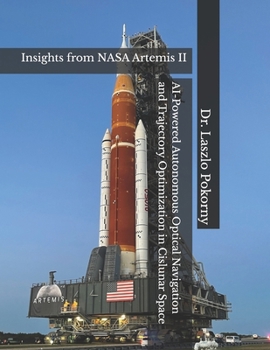
AI-Powered Autonomous Optical Navigation and Trajectory Optimization in Cislunar Space: Insights from NASA Artemis II
No Customer Reviews

As NASA's Artemis program inaugurates a new era of human deep-space exploration, the development of autonomous navigation systems capable of operating independently of Earth-based infrastructure has become an operational imperative. This study investigated the design, implementation, and validation of an integrated artificial intelligence (AI) framework combining convolutional neural network (CNN)-based optical navigation with reinforcement learning (RL)-based trajectory optimization for autonomous guidance, navigation, and control (GNC) in cislunar space, informed by NASA's Artemis II crewed lunar flyby mission launched on April 1, 2026. The study employed a simulation-based experimental design incorporating Circular Restricted Three-Body Problem (CRTBP) dynamics and realistic optical imaging models. A CNN crater detection module processed synthetic navigation imagery against the Robbins (2019) global lunar crater catalog, an Extended Kalman Filter (EKF) fused optical measurements with inertial data for continuous state estimation, and a Proximal Policy Optimization (PPO) reinforcement learning agent computed fuel-optimal trajectory correction maneuvers in real time. Performance was evaluated across 13 quantitative criteria using 200 Monte Carlo simulation runs. The integrated system met 9 of 13 performance criteria, achieving CNN crater detection precision of 0.890, mean average precision of 0.862 at IoU 0.50, crater matching accuracy of 0.866, and position determination within approximately 5 km using purely autonomous onboard processing. The RL controller achieved mean fuel savings of 14.82% over the classical proportional-derivative baseline while simultaneously reducing position tracking error by 22.8%, demonstrating a Pareto improvement in the fuel-accuracy trade space. The system operated within real-time computational constraints (CNN: 0.74 s, EKF: 41 ms, RL: 6.8 ms per cycle), confirming onboard deployment feasibility. The framework is assessed at Technology Readiness Level 3-4 and provides a validated pathway toward AI-enhanced autonomous navigation for Artemis missions and future deep-space exploration in GPS-denied environments.
Format:Paperback
Language:English
ISBN:B0GYT1FNV7
ISBN13:9798259194960
Release Date:April 2026
Publisher:Independently Published
Length:238 Pages
Weight:1.24 lbs.
Dimensions:0.5" x 8.5" x 11.0"
Customer Reviews
0 rating
Copyright © 2026 Thriftbooks.com
Terms of Use | Privacy Policy | Do Not Sell/Share My Personal Information | Cookie Notice | Cookie Preferences | Accessibility Statement
ThriftBooks ® and the ThriftBooks ® logo are registered trademarks of Thrift Books Global, LLC
ThriftBooks ® and the ThriftBooks ® logo are registered trademarks of Thrift Books Global, LLC
