


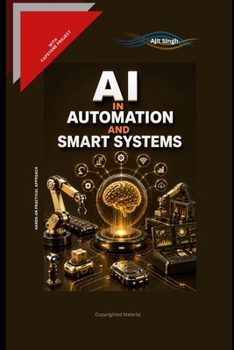
AI in Automation & Smart Systems
No Customer Reviews

The foundational philosophy of AI in Automation & Smart Systems can be summarized in a single directive: Implementation over Theory.
For decades, artificial intelligence has been taught as an abstract, mathematical discipline. While this is useful in a research setting, it fails the modern developer who is tasked with building a functional, automated system for a business. The philosophy of this text dictates that AI is a practical tool, much like a database or a web server, which must be designed, integrated, and deployed efficiently. I believe that learning is most effective when it is tied directly to physical, executable outcomes. Therefore, every concept introduced in this book is immediately followed by a practical application. I bypassed heavy, convoluted mathematical proofs in favor of functional code, robust architectures, and clear deployment strategies. The book respects the reader's time by focusing exclusively on what is necessary to build, set up, and launch smart systems in real-life industry scenarios. Key Features 1. Complete End-to-End Pipeline: Unlike books that only cover model training, this book covers the complete lifecycle: Design, Build, Setup, Implementation, Deployment, and Production. 2. Industry-Relevant Frameworks: Focuses on the latest, updated tools used in current smart systems, including Docker, Kubernetes, Edge AI platforms, and modern Python-based AI libraries. 3. Architectural Focus: Detailed explanations of system components, elements, services, and how they function together in a unified smart architecture. 4. Real-Life Case Studies: Each chapter contains practical examples mirroring real-world industry requirements (e.g., smart manufacturing defect detection, automated smart home hubs, predictive maintenance pipelines). 5. Hardware & Software Integration: Explores the intersection of AI with IoT, edge devices, and physical automation systems, explaining the precise mode of operations for hardware-software handshakes. 6. Live DIY Capstone Project: The final chapter culminates in a complete, working, deployable project with line-by-line code explanations, allowing the reader to build a fully functional smart system from scratch. Key Takeaways By completing this book, readers will extract the following core competencies: 1. Mastery of AI Foundations: A clear understanding of AI classifications, histories, versions, and exactly how they compare and function within industrial automation. 2. Practical Development Skills: The ability to write clean, functional code for machine learning, deep learning, computer vision, and natural language processing applications. 3. Architectural Design: The knowledge to design scalable frameworks and model architectures for IoT and edge computing environments. 4. Deployment Expertise: The capability to set up environments, containerize applications, and push AI models into live, real-world production environments securely. 5. Problem Solving: The capacity to look at a real-life industry requirement, select the appropriate AI service/component, and build a customized, automated smart solution from scratch. Disclaimer: Earnest request from the Author. Kindly go through the table of contents and refer kindle edition for a glance on the related contents. Thank you for your kind consideration
For decades, artificial intelligence has been taught as an abstract, mathematical discipline. While this is useful in a research setting, it fails the modern developer who is tasked with building a functional, automated system for a business. The philosophy of this text dictates that AI is a practical tool, much like a database or a web server, which must be designed, integrated, and deployed efficiently. I believe that learning is most effective when it is tied directly to physical, executable outcomes. Therefore, every concept introduced in this book is immediately followed by a practical application. I bypassed heavy, convoluted mathematical proofs in favor of functional code, robust architectures, and clear deployment strategies. The book respects the reader's time by focusing exclusively on what is necessary to build, set up, and launch smart systems in real-life industry scenarios. Key Features 1. Complete End-to-End Pipeline: Unlike books that only cover model training, this book covers the complete lifecycle: Design, Build, Setup, Implementation, Deployment, and Production. 2. Industry-Relevant Frameworks: Focuses on the latest, updated tools used in current smart systems, including Docker, Kubernetes, Edge AI platforms, and modern Python-based AI libraries. 3. Architectural Focus: Detailed explanations of system components, elements, services, and how they function together in a unified smart architecture. 4. Real-Life Case Studies: Each chapter contains practical examples mirroring real-world industry requirements (e.g., smart manufacturing defect detection, automated smart home hubs, predictive maintenance pipelines). 5. Hardware & Software Integration: Explores the intersection of AI with IoT, edge devices, and physical automation systems, explaining the precise mode of operations for hardware-software handshakes. 6. Live DIY Capstone Project: The final chapter culminates in a complete, working, deployable project with line-by-line code explanations, allowing the reader to build a fully functional smart system from scratch. Key Takeaways By completing this book, readers will extract the following core competencies: 1. Mastery of AI Foundations: A clear understanding of AI classifications, histories, versions, and exactly how they compare and function within industrial automation. 2. Practical Development Skills: The ability to write clean, functional code for machine learning, deep learning, computer vision, and natural language processing applications. 3. Architectural Design: The knowledge to design scalable frameworks and model architectures for IoT and edge computing environments. 4. Deployment Expertise: The capability to set up environments, containerize applications, and push AI models into live, real-world production environments securely. 5. Problem Solving: The capacity to look at a real-life industry requirement, select the appropriate AI service/component, and build a customized, automated smart solution from scratch. Disclaimer: Earnest request from the Author. Kindly go through the table of contents and refer kindle edition for a glance on the related contents. Thank you for your kind consideration
Format:Paperback
Language:English
ISBN:B0H6TRN7J9
ISBN13:9798184664729
Release Date:June 2026
Publisher:Independently Published
Length:292 Pages
Weight:0.87 lbs.
Dimensions:0.6" x 6.0" x 9.0"
Customer Reviews
0 rating
Copyright © 2026 Thriftbooks.com
Terms of Use | Privacy Policy | Do Not Sell/Share My Personal Information | Cookie Policy | Cookie Preferences | Accessibility Statement
ThriftBooks ® and the ThriftBooks ® logo are registered trademarks of Thrift Books Global, LLC
ThriftBooks ® and the ThriftBooks ® logo are registered trademarks of Thrift Books Global, LLC
