


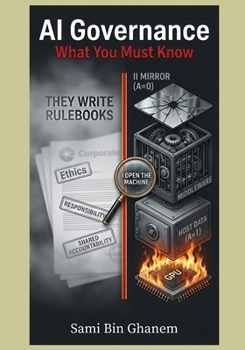
AI Governance - What You Must Know

They sold you "Ethical AI," "Responsible AI," and "Shared Responsibility."
They never defined what an AI System actually is because a real definition would expose the lie.
The industry writes essays on "AI Governance" but refuses to define the terms.
This book defines them - precisely, forensically, and without fog.
The Governance Pivot: From Abstract Ethics to What Is Actually Required
Most AI governance talks about ethics, fairness, transparency.
This book shifts the discussion toward what is actually required:
- Ownership of the machine (four layers, not one)
- Liability of the host (you are the only defendant unless you contract otherwise)
- True cost (the hidden furnace of O(n ), energy, water, e-waste)
- Control over infrastructure (your Layer2 data and Layer3 cage)
- Enforcement through architecture - not through unenforceable principles
That is a different governance lens. It is the most distinctive aspect of this text.
One is philosophy. The other is architecture.
One writes rulebooks. The other opens the machine.
One protects vendors. The other arms the host.
What This Book Defines - That No Other Framework Does
- AI System - four distinct layers (hardware, host data, middleware, II mirror) with ownership assigned to each. No other framework does this.
- Agentic AI - a marketing label for the same four layers with a middleware permission slip. Still A=0, still host-liable.
- AI Governance - not ethics or principles, but Host Damage Control: the host's responsibility to keep the mirror aligned, fix its hallucinations, and bear 100% of the liability.
Why doesn't the industry define these terms?
Because a clear definition would expose the illusion and would prevent the legal shift that makes vendors immune and hosts the only defendants.
You are the host. This book is your defense.
What You Will Learn Inside
- The four layers of an AI System - who owns each, who pays, who validates, and who walks away.
- Why Big Operations failed - the O(n ) furnace, the thermodynamic cost, and why only Mini Operations remain.
- The truth about "Agentic AI" - a permission slip, not a new intelligence.
- The real definition of AI Governance - host damage control, not ethics essays.
- How vendors achieve immunity - EULAs and mainstream frameworks that never assign liability.
- Why "Sovereign AI" is a surveillance pipeline - collecting citizen data under false flags.
- The host's defense - how to evaluate vendors, write governance that protects you, build deterministic cages, and replace transactional purchasing with SRM (Supplier Relationship Management) .
Who Needs This Book
- Enterprise executives - stop being sold illusions. Understand the machine.
- Procurement professionals - learn why transactional purchasing fails and why SRM is the only answer.
- IT engineers - build real cages, not fake governance.
- Risk and compliance professionals - know who really pays when the mirror fails.
- Policymakers - write laws that open the machine, not just protect vendors.
- Citizens and taxpayers - see through "Sovereign AI" surveillance.
The industry will not thank you for reading this book.
Your organization definitely will.
Others write rulebooks. Ghanem defines the machine.
That is the difference between AI Governance theatre and architectural forensics.
Order your copy today before the mirror drifts and the court date arrives.
Customer Reviews
ThriftBooks ® and the ThriftBooks ® logo are registered trademarks of Thrift Books Global, LLC
