


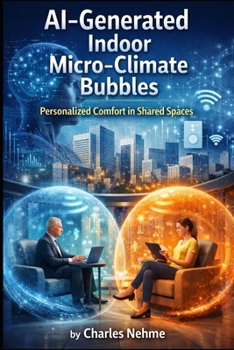
AI-Generated Indoor Micro-Climate Bubbles: Personalized Comfort in Shared Spaces

For decades, indoor climate control has been designed around a simple assumption: if a room is comfortable on average, the occupants will be comfortable as well. Reality has consistently proven otherwise. In offices, hospitals, homes, and public spaces, one person reaches for a sweater while another opens a window-both occupying the same room, yet experiencing entirely different thermal realities.
This book challenges the traditional notion of uniform indoor conditioning and introduces a new paradigm: AI-generated indoor micro-climate bubbles. Instead of forcing occupants to adapt to buildings, buildings can now adapt-intelligently and dynamically-to occupants.
Advances in artificial intelligence, sensor technologies, airflow control, and decentralized HVAC components have made it possible to create personalized thermal environments around individuals. These micro-climate bubbles allow one person to experience 22 C while another enjoys 25 C in the same space-without discomfort, drafts, or conflict.
This book explores the engineering principles, system architectures, and real-world applications behind this transformation. It bridges HVAC fundamentals with AI-driven control strategies, offering a practical and forward-looking guide for professionals shaping the next generation of indoor environments.
The future of HVAC is no longer about controlling rooms.It is about understanding people.
Customer Reviews
ThriftBooks ® and the ThriftBooks ® logo are registered trademarks of Thrift Books Global, LLC
