


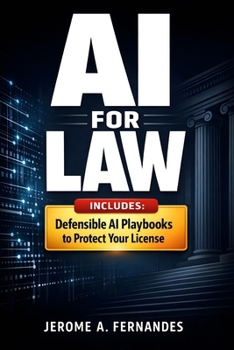
AI for Law: A Practical Guide to Using AI Responsibly in Legal Practice

Law is entering its most consequential transformation since the invention of search.
Generative AI can accelerate research, drafting, discovery, and compliance - but it also introduces new failure modes: hallucinated citations, privilege leaks, bias, and professional responsibility risk. Courts are paying attention. Insurers are paying attention. Clients are paying attention. The margin for error has never been thinner.
AI for Law is written for attorneys, in-house counsel, legal operations leaders, and public-sector professionals who must adopt AI without compromising ethics, defensibility, or their law license.
This is not a tech tutorial or a tool roundup. It is a practical, evidence-driven playbook for deploying AI in legal workflows with zero-trust verification, measurable quality, and governance that stands up to scrutiny.
INCLUDED IN THIS BOOK
The 8-Week AI Pilot Playbook: A controlled, scientific protocol for running your first AI experiment - from defining control groups to setting go/no-go metrics.7 Core Strategic Frameworks: Proven mental models including the C.O.R.E. assessment, the S.T.A.R. delegation model, and the P.A.C.E. negotiation protocol.The "Gold Standard" Prompt Library: Engineered, cut-and-paste prompts for deposition gap hunting, statutory de-coding, automated redlining, and structured legal analysis.The Governance & Risk Suite: Customizable templates for acceptable use policies, vendor due diligence questionnaires, and a legal AI risk register.Defensibility Checklists: Zero-trust verification, the C.I.T.E. citation audit, and Rule 901 admissibility protocols to prevent catastrophic errors.The Evaluation Toolkit: Mathematical methods and sampling tables to measure recall versus precision in discovery and content review.Practice-Specific Case Studies: Before-and-after transformations across litigation, M&A, in-house compliance, and public-sector courts.WHAT'S INSIDE THIS BOOK
Part I: The Shift & The Science
Why legal work is moving from search to synthesis, how large language models actually behave, and why zero-trust grounding with retrieval is mandatory.
Part II: Core Practice Workflows
Litigation, transactional, in-house, and knowledge management use cases - redesigned for semantic research, defensible discovery, and scalable execution.
Part III: The Legal Engineer Toolkit
Prompt engineering as specification, the modern legal AI tech stack, rigorous procurement, and quantitative quality control using golden sets.
Part IV: Ethics, Risk & Governance
Professional responsibility, confidentiality, bias auditing, security controls, and courtroom challenges - including admissibility and deepfake defenses.
Part V: The Future of the Profession
Role evolution, new business models beyond the billable hour, and preparation for agentic workflows and multimodal evidence.
The Reference Library
Ready-to-use policies, vendor questionnaires, risk registers, prompt libraries, and verification checklists you can deploy immediately.
If AI is already influencing legal work, this book shows you how to stay competent, defensible, and in control.
Written for lawyers, legal operations leaders, compliance teams, judges, and policymakers who demand accuracy, accountability, and professional integrity - not black-box shortcuts.
Customer Reviews
ThriftBooks ® and the ThriftBooks ® logo are registered trademarks of Thrift Books Global, LLC
