


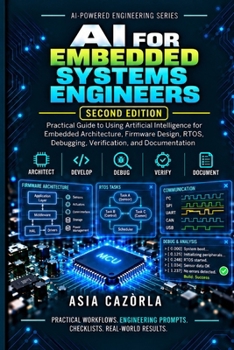
AI For Embedded Systems Engineers (II Edition): Using Artificial Intelligence to Develop Better Firmware Faster

Artificial Intelligence is changing the way embedded systems engineers analyze requirements, design architectures, develop firmware, investigate failures, and verify products.
AI for Embedded Systems Engineers - Second Edition presents a practical methodology for integrating AI across the complete embedded development lifecycle while keeping engineering judgment, verification, and physical evidence at the center.
The core principle is simple:
AI can propose, analyze, compare, organize, and accelerate. The engineer verifies and decides.
This second edition expands the original approach into a more complete engineering workflow, covering the interaction between hardware, firmware, real-time software, power, communications, testing, reliability, production, and field support.
Inside the book you will learn how to use AI for:
- Requirements engineering, ambiguity detection, and traceability
- MCU, MPU, SoC, and FPGA selection
- Embedded architecture and hardware/firmware partitioning
- Communication-interface planning and system tradeoffs
- Power management, battery-life estimation, and low-power design
- Sensors, analog interfaces, signal conditioning, and actuator control
- PCB and hardware/firmware co-design
- Firmware architecture, HALs, drivers, state machines, and modular design
- Peripheral configuration, interrupts, DMA, and timing analysis
- RTOS task design, priorities, queues, semaphores, mutexes, and concurrency
- Memory, performance, and code optimization
- Debugging, hypothesis generation, and root-cause analysis
- Verification, validation, test coverage, and laboratory measurements
- Reliability, fault tolerance, functional safety, and cybersecurity
- Manufacturing test, calibration, production-data analysis, and field failures
The book goes beyond generic AI prompting. It shows how to create structured engineering interactions where assumptions are explicit, missing information is identified, and every important recommendation can be traced back to authoritative sources, calculations, simulations, or measurements.
You will also find reusable prompt patterns, professional review checklists, verification workflows, and a practical low-power sensor-node case study that connects requirements, MCU selection, sensing, wireless communication, power budgeting, firmware strategy, and validation.
The final chapters explore the future AI-assisted engineering workstation, where requirements, datasheets, EDA tools, IDEs, test instruments, production data, and field evidence become part of a connected engineering environment.
Designed for embedded systems engineers, firmware developers, hardware engineers, electronics engineers, PCB designers, test engineers, technical leads, and system architects, this book provides a structured framework for using AI without sacrificing engineering rigor.
AI for Embedded Systems Engineers - Second Edition is not about replacing the engineer. It is about building a faster, more traceable, more systematic, and more evidence-driven embedded development process.
Customer Reviews
ThriftBooks ® and the ThriftBooks ® logo are registered trademarks of Thrift Books Global, LLC
