


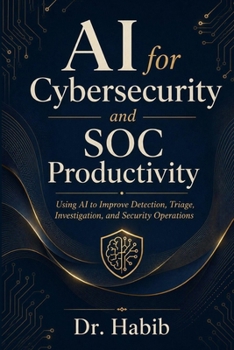
AI for Cybersecurity and SOC Productivity: Using AI to Improve Detection, Triage, Investigation, and Security Operations
No Customer Reviews

AI for Cybersecurity and SOC Productivity has moved from a specialist concern into ordinary professional decisions. In practice, the work now connects security objective, telemetry and context, ai assistance, analyst workflow. A useful output may appear quickly, but the quality of the decision still depends on purpose, source evidence, authority, operating conditions, and the ability to explain what happened.
The central difficulty is that activity can look like capability. A team may own tools, run demonstrations, or produce polished reports while still lacking a dependable method. Common failure patterns in this field include allowing generated indicators or timelines to enter a case without source verification; measuring response speed while hiding correction and missed-evidence rates; granting an AI agent broad response authority because the interface is convenient. These are not minor documentation defects. They can distort decisions, expose sensitive information, create unsafe authority, or leave an organization unable to reconstruct why an action was taken.
This book therefore treats AI-enabled SOC as an operating capability rather than a product feature. The reader is asked to define the decision, map the complete system, use precise language, select proportionate methods, control the workflow, retain evidence, measure the result, and keep accountability with the person or body authorized to decide.
A continuing scenario follows Meridian Manufacturing, which is dealing with a distributed manufacturing company using SIEM, EDR, identity, cloud, network, and OT telemetry across a twenty-four-hour security operation. The scenario is deliberately realistic: useful opportunities exist, but so do incomplete data, handoffs, exceptions, supplier dependencies, operational pressure, and competing interpretations of success. The case shows how professional judgment changes the design before it changes the conclusion.
Evidence is a recurring discipline. The minimum working record includes SOC AI use-case and authority map, telemetry and context register, prompt or workflow specification, analyst verification and case record, automation test and rollback evidence. These artifacts allow another professional to review the claim, repeat the important test, identify the applicable version, understand exceptions, and see who accepted the remaining uncertainty or risk.
Measurement is also treated as part of design. Relevant measures include triage accuracy and correction rate, time to validated understanding, source-link completeness, false escalation and missed-evidence rate. No measure is presented as self-explanatory. Each requires a definition, baseline, source, owner, review frequency, threshold, and action so that activity counts do not substitute for an outcome.
The professional standard is simple to state and demanding to meet: explain the system at a useful level, test the claim, place the work inside a controlled workflow, and remain accountable for the result. The rest of the book turns that standard into observable work.
The central difficulty is that activity can look like capability. A team may own tools, run demonstrations, or produce polished reports while still lacking a dependable method. Common failure patterns in this field include allowing generated indicators or timelines to enter a case without source verification; measuring response speed while hiding correction and missed-evidence rates; granting an AI agent broad response authority because the interface is convenient. These are not minor documentation defects. They can distort decisions, expose sensitive information, create unsafe authority, or leave an organization unable to reconstruct why an action was taken.
This book therefore treats AI-enabled SOC as an operating capability rather than a product feature. The reader is asked to define the decision, map the complete system, use precise language, select proportionate methods, control the workflow, retain evidence, measure the result, and keep accountability with the person or body authorized to decide.
A continuing scenario follows Meridian Manufacturing, which is dealing with a distributed manufacturing company using SIEM, EDR, identity, cloud, network, and OT telemetry across a twenty-four-hour security operation. The scenario is deliberately realistic: useful opportunities exist, but so do incomplete data, handoffs, exceptions, supplier dependencies, operational pressure, and competing interpretations of success. The case shows how professional judgment changes the design before it changes the conclusion.
Evidence is a recurring discipline. The minimum working record includes SOC AI use-case and authority map, telemetry and context register, prompt or workflow specification, analyst verification and case record, automation test and rollback evidence. These artifacts allow another professional to review the claim, repeat the important test, identify the applicable version, understand exceptions, and see who accepted the remaining uncertainty or risk.
Measurement is also treated as part of design. Relevant measures include triage accuracy and correction rate, time to validated understanding, source-link completeness, false escalation and missed-evidence rate. No measure is presented as self-explanatory. Each requires a definition, baseline, source, owner, review frequency, threshold, and action so that activity counts do not substitute for an outcome.
The professional standard is simple to state and demanding to meet: explain the system at a useful level, test the claim, place the work inside a controlled workflow, and remain accountable for the result. The rest of the book turns that standard into observable work.
Format:Paperback
Language:English
ISBN:B0H9RPDJK6
ISBN13:9798188295271
Release Date:July 2026
Publisher:Independently Published
Length:94 Pages
Weight:0.30 lbs.
Dimensions:0.2" x 6.0" x 9.0"
Customer Reviews
0 rating
Copyright © 2026 Thriftbooks.com
Terms of Use | Privacy Policy | Do Not Sell/Share My Personal Information | Cookie Notice | Cookie Preferences | Accessibility Statement
ThriftBooks ® and the ThriftBooks ® logo are registered trademarks of Thrift Books Global, LLC
ThriftBooks ® and the ThriftBooks ® logo are registered trademarks of Thrift Books Global, LLC
