


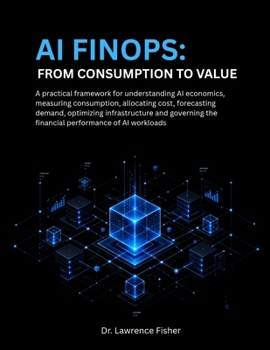
AI FinOps From Consumption to Value: A Practical Framework for Understanding AI Economics, Measuring Consumption, Allocating Costs, Forecasting Demand
No Customer Reviews

AI is transforming how organizations build and deliver software-but it is also transforming how technology costs are created.
A single AI request can trigger multiple model calls, thousands of tokens, retrieval operations, tool calls, database activity, infrastructure consumption, retries, and other hidden workloads. As AI systems become more sophisticated, simply looking at a cloud bill or counting tokens is no longer enough to understand what AI actually costs. AI FinOps: From Consumption to Value provides a practical framework for understanding, measuring, allocating, forecasting, and managing the economics of modern AI workloads. Rather than treating AI cost optimization as a simple exercise in reducing token usage or choosing the cheapest model, this book shows how to connect technical consumption, financial expenditure, workload behavior, ownership, and business value. Inside, you will learn how to: Understand the foundations of AI FinOps and how it extends traditional FinOps practicesBreak down the AI cost stack, from business activity and applications to workflows, model calls, tokens, inference, GPUs, and infrastructureIdentify the real cost drivers of AI workloads, including tokens, model calls, context, retrieval, tool use, retries, storage, networking, and observabilityUnderstand LLM consumption and the hidden sources of token usageAnalyze cached and reasoning-related consumption and why different usage measurements matterEvaluate AI infrastructure and inference economics, including GPU capacity, utilization, throughput, and performanceUnderstand the economic differences between managed AI APIs and self-hosted AI infrastructureBuild meaningful AI cost metrics and unit economics instead of relying solely on cost per token or cost per requestDesign AI cost observability and telemetry that connects application behavior with financial dataTrace multi-step AI workflows, agents, retrieval systems, tools, and retriesBuild defensible AI cost allocation and attribution models across applications, teams, products, and tenantsDevelop AI cost forecasts, budgets, spending boundaries, and anomaly detectionEstablish controls for runaway or unexpected AI consumptionBuild a practical AI FinOps baseline that connects workloads, consumption, cost, attribution, forecasts, KPIs, and controlsMove from simply asking "How much did we spend?" to understanding "What did we consume, why did we consume it, who owns it, and what value did it create?"The book also addresses an important principle that is often overlooked in AI cost management: the cheapest configuration is not necessarily the most economically efficient one. Cost decisions must be considered alongside performance, quality, reliability, and risk.
Whether you are building AI applications, managing cloud and GPU infrastructure, working in FinOps or Finance, leading AI engineering, or making product and technology investment decisions, this book provides a structured way to reason about the financial performance of AI workloads. AI FinOps is not just about reducing the AI bill. It is about making AI economics understandable enough to make better decisions. If you want to understand where AI spending comes from, measure it accurately, assign it responsibly, forecast where it is going, and determine whether that spending is producing sufficient value, AI FinOps: From Consumption to Value gives you the framework to do it.Format:Paperback
Language:English
ISBN:B0HHZHK9VF
ISBN13:9798171889845
Release Date:September 2026
Publisher:Independently Published
Length:150 Pages
Weight:0.80 lbs.
Dimensions:0.3" x 8.5" x 11.0"
Customer Reviews
0 rating
Copyright © 2026 Thriftbooks.com
Terms of Use | Privacy Policy | Do Not Sell/Share My Personal Information | Cookie Notice | Cookie Preferences | Accessibility Statement
ThriftBooks ® and the ThriftBooks ® logo are registered trademarks of Thrift Books Global, LLC
ThriftBooks ® and the ThriftBooks ® logo are registered trademarks of Thrift Books Global, LLC
