


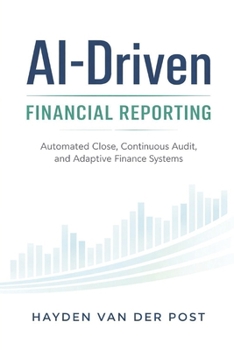
AI-Driven Financial Reporting: Automated Close, Continuous Audit, and Adaptive Finance Systems

Finance is entering a new operating era where reporting, controls, and assurance are no longer periodic, manual, and backward-looking. AI-driven architectures are reshaping how financial data is captured, validated, reconciled, and reported across the enterprise. This book provides a practical, systems-level view of how modern finance teams can design and operate AI-driven financial reporting environments that are faster, more accurate, and continuously verifiable.
AI-Driven Financial Reporting explores how organizations are moving beyond traditional month-end processes toward automated close workflows, continuous audit readiness, and adaptive finance system design. Rather than focusing on theory or hype, this book breaks down the actual data pipelines, control frameworks, and automation layers required to support production-grade finance operations in an AI-enabled environment.
Inside, you will learn how automated close architectures reduce cycle times while improving traceability, how continuous audit models change the relationship between finance and assurance, and how adaptive finance systems improve resilience as business conditions, regulations, and data volumes evolve. The book also examines governance, risk, and internal control considerations to ensure automation strengthens compliance rather than introducing new operational risk.
Designed for finance leaders, controllers, FP&A teams, audit professionals, and financial systems architects, this guide bridges the gap between enterprise finance strategy and real-world implementation. Whether you are modernizing legacy reporting processes or designing a next-generation finance data stack, this book provides a clear framework for building scalable, AI-driven financial reporting capabilities.
This is a technical and strategic playbook for organizations preparing finance functions for a continuous, data-driven future.
Customer Reviews
ThriftBooks ® and the ThriftBooks ® logo are registered trademarks of Thrift Books Global, LLC
