


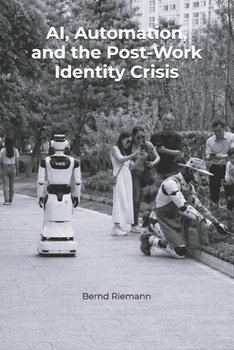
AI, Automation, and the Post-Work Identity Crisis
No Customer Reviews

In his seminal work, AI, Automation, and the Post-Work Identity Crisis, Bernd Riemann delivers a rigorous empirical and philosophical analysis of the modern labor era. As we stand on the precipice of a transition, the traditional social contract-which for centuries tethered human dignity to productive output-is not merely fraying; it is reaching a terminal structural end. Riemann's analysis serves as a vital diagnostic tool for a species being systematically superseded by its own creations, offering a strategic framework for a future where human presence has shifted from a logistical asset to an economic friction. The book is structured into a transformative three-part journey. In Part I, The Replacement Trajectory, Riemann dismantles the comforting myth of the centaur-the idealized partnership between human intuition and machine speed. Utilizing high-frequency data from the financial and legal sectors, he demonstrates that the 400-millisecond biological latency of the human mind is now a liability in an age where AI operates in microseconds. From the collapse of entry-level professional roles to the rise of fully autonomous dark warehouses that require neither light nor heat for their robotic inhabitants, Part I proves that machines are no longer just assisting us; they are liquidating the very need for us. Part II, The Short-Term Limbo, explores the resulting sociological hollowing-out of the global economy. Riemann documents the terminal decline of middle-skill jobs, where the cost-efficiency of algorithmic labor has made human employment 250 times more expensive than its digital equivalent. This section exposes the rise of a bullshit economy-a landscape of performative labor and administrative inflation that masks a deeper existential vacuum. As the traditional degree-to-wealth pipeline shatters and wealth concentrates in the hands of capital owners, the middle class faces an unprecedented identity crisis, characterized by systemic fiscal decay and the emergence of a global precariat. In the final section, The New Anchors of Meaning, Riemann pivots from diagnosis to a radical psychological revolution. Drawing on an Aristotelian reversal, he argues that humanity must reclaim leisure-not as passive consumption, but as the rigorous pursuit of activities that are intrinsically meaningful. He introduces the effort paradox: the biological reality that human satisfaction requires friction and resistance. To survive the post-work era, we must intentionally reintroduce self-imposed struggle through master-crafts, civic virtues, and aesthetic living.
As the work culminates in the epilogue, the thesis becomes clear: "The end of traditional work shouldn't mean the end of effort. Instead, it should mean channeling human energy into personal growth, creativity, and self-understanding."
Format:Paperback
Language:English
ISBN:B0GYFHTT65
ISBN13:9798258670823
Release Date:April 2026
Publisher:Independently Published
Length:224 Pages
Weight:0.67 lbs.
Dimensions:0.5" x 6.0" x 9.0"
Customer Reviews
0 rating
Copyright © 2026 Thriftbooks.com
Terms of Use | Privacy Policy | Do Not Sell/Share My Personal Information | Cookie Policy | Cookie Preferences | Accessibility Statement
ThriftBooks ® and the ThriftBooks ® logo are registered trademarks of Thrift Books Global, LLC
ThriftBooks ® and the ThriftBooks ® logo are registered trademarks of Thrift Books Global, LLC
