


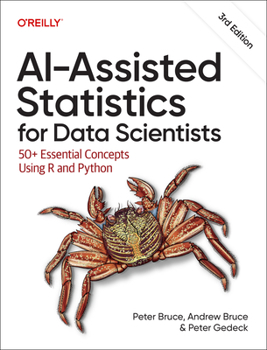
Ai-Assisted Statistics for Data Scientists: 50+ Essential Concepts Using R and Python

Statistical methods are a key part of data science, yet few data scientists have formal statistical training. Courses and books on basic statistics rarely cover the topic from a data science perspective. The third edition of this popular guide expands its practical foundations in R and Python into the modern AI toolkit, with new chapters on neural networks, deep learning, and large language models. Generative AI is integrated throughout, showing how tools such as ChatGPT, Claude, and Gemini work, and how they can support real-world statistical workflows.
This book highlights concepts that matter most when working with data, building predictive models, and deploying AI responsibly. If you're comfortable with R or Python and have had some exposure to basic statistics, this concise reference will boost your statistical literacy, your understanding of how AI works, and your confidence in real-world data science and AI projects.
Conduct exploratory analysis of data to improve quality and model outcomes Apply sampling and experimental design to reduce bias and answer questions with clarity Use regression to understand data-generating processes and detect anomalies Build predictive models using classification, clustering, and unsupervised learning with unbalanced dataCustomer Reviews
ThriftBooks® and the ThriftBooks® logo are registered trademarks of Thrift Books Global, LLC
