


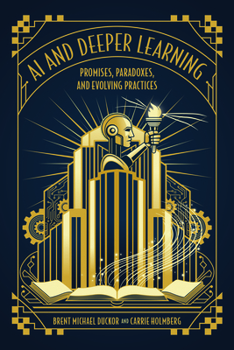
AI and Deeper Learning: Promises, Paradoxes, and Evolving Practices

A guide for educators seeking to strengthen their role as designers of meaningful learning experiences and stewards of ambitious, equitable practice in an increasingly AI-mediated world
As artificial intelligence (AI) tools rapidly reshape K-12 classrooms, teachers, leaders, parents, and policymakers confront urgent questions: What counts as learning when machines can generate fluent essays, summarize complex texts, and simulate understanding? How do we distinguish between interactive learning--where students engage in productive struggle, reflection, and growth--and interpassive learning, an emerging phenomenon where cognitive effort is delegated to technology in ways that undercut student development?
AI and Deeper Learning advances a research-based framework for responsible uses of AI in classrooms. Drawing on the work of John Dewey, Lev Vygotsky, and other scholars in the sociocultural tradition, Brent Michael Duckor and Carrie Holmberg revisit foundational debates about learner development, the nature of learning, and the purposes of education. Arguing that we are in the midst of a paradigm shift in teaching and learning, the authors offer new directions for addressing paradoxes of instruction with AI-focused practices.
Through vivid classroom examples highlighting teacher dilemmas, the book introduces five pillars--Accuracy, Agency, Accessibility, Assessment, and Authenticity--as an integrated framework for guiding ethical, human-centered, and instructionally meaningful AI practice in schools. Across the chapters, readers encounter teachers and students confronting AI hallucinations, the erosion of student voice, automated versus authentic feedback, and the outsourcing of productive struggle in the learning process, among other tensions.
The book's practical design principles encourage educators to use their pedagogical judgment and make principled decisions about whether, when, or how AI belongs in the learning process. It provides guiding questions, reflective exercises, and resources that help K-12 teachers, professional learning communities, and teacher educators design instruction that cultivates deeper learning and ambitious teaching in AI-mediated classrooms.
Customer Reviews
ThriftBooks® and the ThriftBooks® logo are registered trademarks of Thrift Books Global, LLC
