


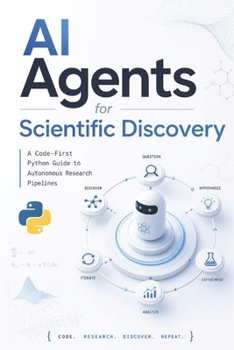
AI Agents for Scientific Discovery: A Code-First Python Guide to Autonomous Research Pipelines

Accelerate scientific workflows by engineering autonomous AI agents with Python.
AI Agents for Scientific Discovery provides a hands-on, code-first framework for building software systems capable of designing experiments, analyzing data, and coordinating complex research tasks. As laboratory datasets scale and computational methods advance, multi-agent systems offer a structured way to automate routine technical pipelines and accelerate data exploration.
This book guides developers, data scientists, and computational researchers through the architecture and implementation of agentic workflows. Step-by-step code examples demonstrate how to construct modular agents, integrate domain-specific tools, and manage autonomous execution loops cleanly and reliably.
What You Will LearnAgent Architecture: Design modular Python systems tailored for scientific reasoning and data handling.
Pipeline Automation: Construct execution loops that manage input parsing, execution, and validation.
Multi-Agent Coordination: Organize specialized agents to divide, execute, and cross-check complex research tasks.
Tool Integration: Connect LLM-driven logic with external Python libraries, APIs, and scientific databases.
System Reliability: Implement structured fallback mechanisms, error handling, and state management for autonomous workflows.
AudienceDesigned for Python developers, software engineers, data scientists, and technical researchers looking to implement autonomous agent systems in scientific and technical environments. Familiarity with intermediate Python and basic machine learning concepts is recommended.
Customer Reviews
ThriftBooks ® and the ThriftBooks ® logo are registered trademarks of Thrift Books Global, LLC
