


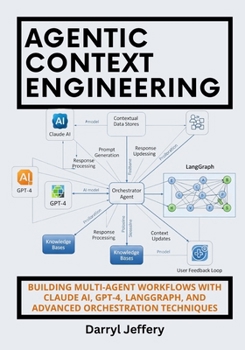
Agentic Context Engineering: Building Multi-Agent Workflows with Claude AI, GPT-4, LangGraph, and Advanced Orchestration Techniques

Agentic Context Engineering: Building Multi-Agent Workflows with Claude AI, GPT-4, LangGraph, and Advanced Orchestration Techniques
The next wave of AI isn't about bigger models-it's about smarter collaboration. As organizations demand reliability, transparency, and scalability, multi-agent systems are emerging as the future of applied AI. This book shows you how to design, orchestrate, and scale agentic workflows that combine the strengths of Claude AI, GPT-4, and LangGraph to solve real problems.
Agentic Context Engineering provides a comprehensive guide to mastering the principles of context management and agent orchestration. It is written for developers, researchers, and AI practitioners who want to go beyond single-prompt interactions and build systems that reason, validate, and generate collectively. Whether you're creating AI research assistants, customer support solutions, or enterprise-grade workflows, this book will help you design systems that are resilient, explainable, and production-ready.
What sets this book apart is its structured approach, blending theory with practical examples and code. You will learn:
Foundations of Agentic Context Engineering - how context shapes multi-agent reasoning and why orchestration matters.
Multi-Agent Design Fundamentals - defining roles, goals, and communication pathways to prevent redundancy and deadlocks.
Context Flows and Memory Structures - strategies for balancing short-term context windows with persistent memory and vector databases.
Claude AI and GPT-4 in Multi-Agent Systems - leveraging Claude's reasoning strengths and GPT-4's generative capabilities in complementary ways.
LangGraph for Agent Orchestration - building, scaling, and managing workflows through graph-based design with annotated code.
Advanced Orchestration Techniques - role-based delegation, negotiation, and collective planning across agents.
Reliability, Safety, and Explainability - preventing hallucination propagation, building auditable workflows, and handling errors gracefully.
Scaling for Real-World Applications - deployment patterns, external integrations, and optimization for latency, cost, and throughput.
Case Studies - detailed examples of research assistants, automated customer support, and enterprise workflows in action.
Future Directions - trends, standards, and how agentic context engineering will define the next decade of AI.
If you want to move beyond isolated prompts and build intelligent, orchestrated systems that work in real-world environments, this book gives you the frameworks, techniques, and insights you need.
Take the next step in your AI expertise-equip yourself with the skills to build the multi-agent workflows that will define the future. Get your copy of Agentic Context Engineering today.
Customer Reviews
ThriftBooks® and the ThriftBooks® logo are registered trademarks of Thrift Books Global, LLC
