


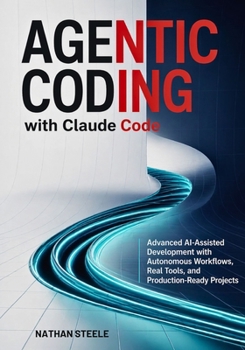
Agentic Coding with Claude Code: Advanced AI-Assisted Development with Autonomous Workflows, Real Tools, and Production-Ready Projects

Move beyond basic AI prompting and learn how to build controlled, reliable coding workflows with Claude Code.
AI-assisted coding can produce impressive results, but real software development requires more than a good prompt. When a task spans multiple files, dependencies, edge cases, debugging steps, and production constraints, unstructured prompting can lead to drift, hidden errors, and code that looks correct but fails under real conditions.
Agentic Coding with Claude Code is a practical guide for developers who want to use Claude Code with more structure, control, and reliability. Instead of treating AI as a one-shot code generator, this book shows you how to design agentic coding workflows that plan, execute, verify, fix, and refine work step by step.
Inside, you will learn how to:
Build structured AI-assisted coding workflows using the Plan → Execute → Verify → Fix loopReduce hallucinations, false confidence, context drift, and silent failuresUse verification layers, tests, checks, and assertions to validate generated codeStructure projects so Claude Code can work more reliably across filesDebug agentic systems by tracing errors step by stepManage memory, context, and consistency across longer workflowsBuild a codebase assistant for understanding and modifying existing projectsCreate an automation CLI tool for repeatable development tasksDesign an autonomous dev agent that plans, executes, self-checks, and refinesApply guardrails, human review, and production-minded workflow controlThis book is written for readers who already understand the basics of AI-assisted coding and want to move toward more dependable, real-world development workflows. It is not an installation guide or a collection of generic prompts. It is a concise, execution-focused guide to building controlled systems with Claude Code.
If you want to stop relying on unpredictable AI outputs and start building repeatable coding workflows that are easier to verify, debug, and scale, this book gives you a practical path forward.
Nathan Steele writes practical technical guides for developers, builders, and self-learners who want clear, modern, execution-focused instruction. His work emphasizes real workflows, debugging discipline, production thinking, and practical systems readers can apply in their own projects.
Customer Reviews
ThriftBooks ® and the ThriftBooks ® logo are registered trademarks of Thrift Books Global, LLC
