


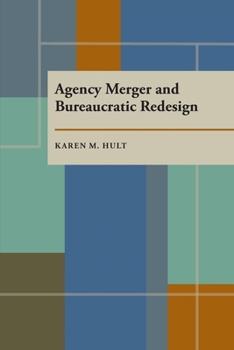
Agency Merger and Bureaucratic Redesign (Pitt Series in Policy and Institutional Studies)
No Customer Reviews

Select Format
Select Condition 
Book Overview
Since the expansion of public programs in the 1960s, charges of bureaucratic inefficiency, unresponsiveness, and red tape have been rampant. The response has often been extensive reorganization in an effort to change the source of control, carry out specific missions, and to achieve greater inter-agency cooperation. Karen M. Hult examines why these restructurings often fail, through three case studies: the U.S. Department of Housing and Urban Design (HUD); the Minnesota Department of Energy, Planning, and Development; and the Minneapolis Community Development Agency. Hult's study assesses the usefulness of mergers and reorganizations as a policy tool, and offers a valuable contribution to the study of public management and organization design.
Format:Hardcover
Language:English
ISBN:082293549X
ISBN13:9780822935490
Release Date:July 1987
Publisher:University of Pittsburgh Press
Length:232 Pages
Weight:1.10 lbs.
Dimensions:9.5" x 0.8" x 6.5"
Related Subjects
Business Business & Investing Economics Political Science Politics & Social SciencesCustomer Reviews
0 rating
Copyright © 2026 Thriftbooks.com Terms of Use
| Privacy Policy | Do Not
Sell/Share My Personal Information | Cookie Policy | Cookie Preferences | Accessibility Statement
ThriftBooks® and the ThriftBooks® logo are registered trademarks of Thrift Books Global, LLC
ThriftBooks® and the ThriftBooks® logo are registered trademarks of Thrift Books Global, LLC
