


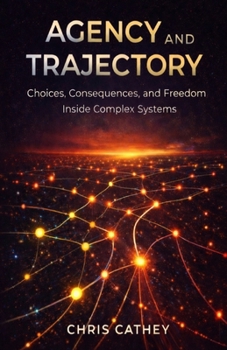
Agency and Trajectory: Choices, Consequences, and Freedom Inside Complex Systems

Agency and Trajectory challenges the way freedom and determinism are usually discussed.
Most debates treat free will as a metaphysical question. Either humans are fully free, or everything is determined by prior causes. Both positions miss how real decision making actually works inside living systems.
This book reframes the problem using cybernetics, systems theory, and ecology.
Human beings do not act outside causality. They act within it. Behavior unfolds through feedback loops, constraints, time delays, and path dependence. Freedom does not mean absence of constraint. It means the ability to regulate direction over time.
Agency is not a momentary power to choose anything at all. It is the capacity to remain steerable.
Drawing from cybernetics, control theory, and systems thinking, Agency and Trajectory shows how choice operates inside real contexts. People encounter choice points where multiple options exist. Decisions collapse those options into a trajectory. Over time, feedback, commitment, and structure either preserve or eliminate future choice points.
The book explains why people often feel trapped despite having choices, why intention does not reliably predict outcomes, and why late attempts at change feel futile. These experiences are not failures of will. They are predictable system dynamics.
Key ideas explored include:
Linear versus circular causality in living systems
Equipotentiality and unequal starting conditions
Equifinality and converging outcomes
Choice points and decision points
Agency as cybernetic regulation
Sensory acuity, feedback, and behavioral flexibility
Requisite variety as the basis of effective control
Reflexivity and self-reflexive consciousness
Ecological evaluation across domains and time horizons
Path dependence, lock-in, and loss of degrees of freedom
Navigation, course correction, and trajectory management
Rather than arguing that people are victims of systems, this book shows how systems actually change. Constraint does not imply fate. Structure shapes possibility without dictating outcomes. Agency exists where feedback can still be interpreted and behavior can still adapt.
The model presented here rejects both fatalism and naive voluntarism. It replaces moral abstractions with functional analysis. Responsibility is not about total control or total helplessness. It follows participation in feedback structures where regulation remains possible.
This book is written for readers interested in human behavior, decision making, psychology, philosophy, systems theory, and real-world change. It is not a self-help manual and not a metaphysical treatise. It is a practical framework for understanding how freedom actually works in complex systems.
Freedom, in this model, is ecological competence. It is the ability to sense change, adjust course, and preserve future options while respecting the larger systems one inhabits.
Determinism describes what happens when regulation fails.
Agency describes what happens before it does.
Customer Reviews
ThriftBooks® and the ThriftBooks® logo are registered trademarks of Thrift Books Global, LLC
