


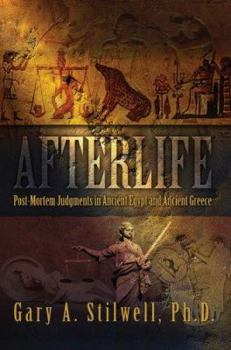
Afterlife: Post-Mortem Judgments in Ancient Egypt and Ancient Greece
No Customer Reviews

Select Format
Select Condition 
Book Overview
Afterlife argues that proper conduct was believed essential for determining one's post-mortem judgment from the earliest periods in ancient Egypt and Greece. Part one examines Plato's eschatological myths regarding conduct as it affects one's afterlife fate. Part two traces the evolution of afterlife beliefs from Homer to the Dramatists and demonstrates that post-mortem reward and retribution, based on one's conduct, is already found in Homer. Pythagoreanism and Orphism further develop the afterlife beliefs that will have such enormous impact on Plato and later Christianity. The third part examines Egyptian religious texts of the 5th to 18th Dynasties for their understanding of virtues and vices that have afterlife consequences. In part four, the relationship between behavior and the afterlife beliefs of both societies are compared. In the earliest periods, the afterlife texts appear to be concerned only with the elite: the king in Egypt's Pyramid Texts and the heroes in Homeric Greece. Nevertheless, we show that, from the earliest times, both societies believed that the gods, primarily Maat in Egypt and Dike in Greece, were responsible for the proper ordering of the cosmos and anyone's violations of that order would reap the direst consequence--the loss of a beneficent afterlife.
Format:Paperback
Language:English
ISBN:0595342809
ISBN13:9780595342808
Release Date:February 2005
Publisher:iUniverse
Length:296 Pages
Weight:0.96 lbs.
Dimensions:0.7" x 6.0" x 9.0"
Customer Reviews
0 rating
Copyright © 2026 Thriftbooks.com Terms of Use
| Privacy Policy | Do Not
Sell/Share My Personal Information | Cookie Policy | Cookie Preferences | Accessibility Statement
ThriftBooks® and the ThriftBooks® logo are registered trademarks of Thrift Books Global, LLC
ThriftBooks® and the ThriftBooks® logo are registered trademarks of Thrift Books Global, LLC
