
Skip to content
Scan a barcode
Scan
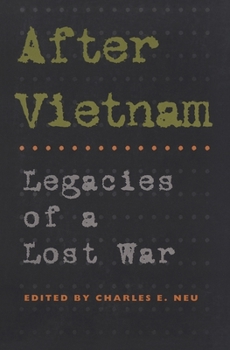
Paperback After Vietnam: Legacies of a Lost War Book

ISBN: 0801863325

ISBN13: 9780801863325

After Vietnam: Legacies of a Lost War

Select Format

Select Condition ThriftBooks Help Icon

Recommended

Format: Paperback

Condition: Very Good

$9.99
Save $18.96!
List Price $28.95
Almost Gone, Only 2 Left!
Save to List

Book Overview

Efforts to understand the impact of the Vietnam War on America began soon after it ended, and they continue to the present day. In After Vietnam four distinguished scholars focus on different elements of the war's legacy, while one of the major architects of the conflict, former defense secretary Robert S. McNamara, contributes a final chapter pondering foreign policy issues of the twenty-first century.

In the book's opening chapter, Charles E. Neu explains how the Vietnam War changed Americans' sense of themselves: challenging widely-held national myths, the war brought frustration, disillusionment, and a weakening of Americans' sense of their past and vision for the future. Brian Balogh argues that Vietnam became such a powerful metaphor for turmoil and decline that it obscured other forces that brought about fundamental changes in government and society. George C. Herring examines the postwar American military, which became nearly obsessed with preventing another Vietnam. Robert K. Brigham explores the effects of the war on the Vietnamese, as aging revolutionary leaders relied on appeals to revolutionary heroism to justify the communist party's monopoly on political power. Finally, Robert S. McNamara, aware of the magnitude of his errors and burdened by the war's destructiveness, draws lessons from his experience with the aim of preventing wars in the future.

Customer Reviews

2 ratings

Excellent review.

This is a very good but brief review of the Vietnam War and its legacies. The editor has brought together five people who were directly or indirectly involved in the war including McNamara. The authors discussed how the war changed the way America saw itself and the world. The war also nudged the military system to dramatically change its ways in order to better adapt to different modalities of warfare. It divided the nation and forced people to question the credibility of the executive branch. On the other hand, the Hanoi government, which promoted a cult of leadership solidarity during the war failed to bring in new blood to the party after 1975. Inability to adapt to the complexities of running a country during peacetime caused severe economic problems as well as charges of corruption. Harsh criticisms and even rebellions from the people, members of the party, and Buddhists occured as a result but were violently suppressed. Failure to break the cult of leadership solidarity will prevent Vietnam country to move forward.

State-of-the-Art Vietnam War Scholarship

Twenty-five years after the United States' war in Vietnam ended, the conflict continues to fascinate. As a result, this slim volume edited by Charles Neu, Professor of History at Brown University, is most valuable. It contains only five essays, but they cover a broad spectrum of issues, from the effect of the Vietnam War on American society to an assessment of the impact on the conflict on the American military to a former Secretary of Defense's "reflections" on the war and related topics. This book sheds considerable light on the most controversial foreign war in American history.Professor Neu's opening essay sets the tone: "The legacy of the Vietnam War is an unending topic." According to Neu, the Vietnam War transformed the U.S. in various ways, including "weakening all of those Cold War assumptions that had crystallized in the late 1940s and guided American leaders through the late 1960s" and "hasten[ing] the decline of the old foreign policy establishment." The war also challenged the "belief in national righteousness and providential destiny." For combat soldiers, according to Neu: "As the war went on, the confusion deepened and old myths dissolved." In World War II, American soldiers "generally had been hailed as liberators;" in Vietnam, the peasantry was wary, if not hostile. Neu implies that this contributed to break downs in discipline, the worst of which occurred in My Lai in 1968, when 400 civilians, including women and children were killed by American troops. In concluding, Neu writes: "Most Americans sensed that the nation had entered a new era after Vietnam, one that was filled with divisions, uncertainties, and moral confusion, both at home and abroad."The essay written by Brian Balogh. Associate Professor of History at the University of Virginia, examines the war's "domestic legacy." Balogh observes that "Vietnam shattered the myth of American invincibility" and explains: "Innocence and omnipotence lost shattered the perception of American exceptionalism." In discussing "the power of the Vietnam metaphor," Balogh asserts: "Vietnam became the cause of many of America's problems." In Balogh's view, Hollywood's treatment of Vietnam as a metaphor "contributed to the impression that the war was behind everything - or at least everything bad - that was happening to America." According to Balogh: "The war and the movement against it seemed to devour every other concern." Balogh concludes: "Metaphors are bad for history" because they are "emotional shorthand that obscures complex causal relationships." George Herring, Professor of History at the University of Kentucky, focuses on the Vietnam War's "profound impact on a once-proud U.S. military establishment." Herring quotes an expert on military affairs that, as early as 1971, there was "a state of approaching collapse." According to Herring, the symptoms included "the hippie-like appearance of GIs in the field," rising AWOL and desertion rates, an "epidemic of `fragging
Copyright © 2026 Thriftbooks.com Terms of Use | Privacy Policy | Do Not Sell/Share My Personal Information | Cookie Policy | Cookie Preferences | Accessibility Statement
ThriftBooks ® and the ThriftBooks ® logo are registered trademarks of Thrift Books Global, LLC

GoDaddy Verified and Secured