


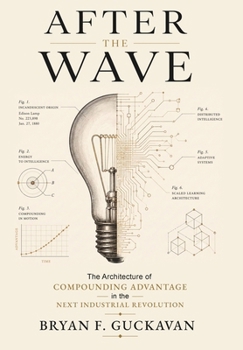
After The Wave: The Architecture of COMPOUNDING ADVANTAGE in the NEXT INDUSTRIAL REVOLUTION

Your enterprise adopted AI. The pilots succeeded. The teams are faster. The adoption metrics are green.
And yet the decisions are not faster. The operating review still runs long. Three functions still present three different numbers for the same metric. The quarterly reconciliation still consumes two weeks of leadership bandwidth that nobody budgets for and everyone accepts as inevitable.
Something is wrong. You can feel it. You do not yet have the words for it.
After the Wave provides them.
This has happened before. When electricity reached the factory floor, most owners bolted electric motors onto architecture designed for steam and saw almost nothing for their money. The gains went to the few who understood that the technology had not improved the old factory. It had made a new kind of factory possible, and they tore out the shafts and belts and rebuilt around the flow of materials. Henry Ford was one of them. The industry leader who once looked Ford over, was unimpressed, and sent him home was not. You have almost certainly never heard his name. That is what displacement looks like from the inside. Not a crash. A silence.
The same pattern separated Walmart from Kmart when computing arrived. The same technology was available to both. One rebuilt its operating architecture around information flow. The other installed systems on top of the organization it already had. The divide took a decade to become visible and was permanent by the time it did.
Bryan Guckavan argues that AI is running the same script, and that most enterprises are playing the losing part. AI is not a technology wave to be ridden. It is an industrial revolution, and revolutions do not reward adoption. They reward the enterprises that redesign around the constraint the technology has shifted. AI made analysis abundant. Any team can now produce more forecasts, more scenarios, more recommendations than the organization can absorb. What is now scarce is decision-grade truth: claims that are traceable, reproducible, and owned by someone accountable for their accuracy. That scarcity, not model capability, is the new competitive bottleneck.
Enterprises that adopt AI without rebuilding for verification are accumulating what Guckavan calls Verification Debt: a compounding backlog of unverified claims, mismatched definitions, and manual reconciliation that quietly becomes a shadow factory inside the business, consuming the very leadership bandwidth the technology was supposed to free.
After the Wave delivers the alternative in full. The Velocity Operating System is a five-layer enterprise architecture that converts abundant AI analysis into defensible decisions at speed. The book specifies the layers, the roles, the feedback loops, and the maturity stages, then shows how verified decision velocity compounds: every decision the system processes makes the next one faster and more trustworthy, an advantage competitors cannot copy by buying the same tools.
For C-suite leaders, board members, and senior strategists, this is the first book in a three-part series on the architecture of compounding advantage. The window for building it is open now. Every prior revolution shows it will not stay open. The ones still measuring adoption will find themselves on the wrong side of a divide that, by the time it becomes visible, has already been lost.
Customer Reviews
ThriftBooks ® and the ThriftBooks ® logo are registered trademarks of Thrift Books Global, LLC
