


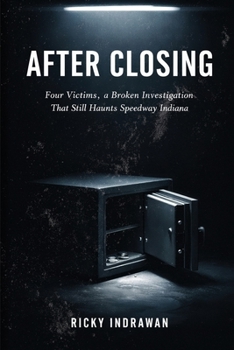
After Closing: Four Victims, a Broken Investigation That Still Haunts Speedway Indiana

Four young workers vanished after closing. The first hours of the investigation may have shaped every unanswered year that followed.
On November 17, 1978, Jayne Friedt, Daniel Davis, Mark Flemmonds, and Ruth Ellen Shelton disappeared from the Burger Chef restaurant on Crawfordsville Road in Speedway, Indiana. Cash was missing. The building stood empty. The earliest assumption treated the night as a theft involving the employees themselves. Two days later, all four were found dead more than twenty miles south in Johnson County. The public record examined in this book contains no charge or verdict.
After Closing reconstructs this historical true crime case from the ordinary routines of the final shift through the discovery of an abandoned car, the southbound movement of the crime, the body-recovery site, witness descriptions, robbery theories, a later confession, and the failure of that confession to produce a prosecutable ending. The book follows the public record without turning uncertainty into proof.
At the center of the investigation is a damaged first scene. The restaurant was cleaned and reopened before it received the full forensic attention the case required. Potential evidence disappeared into routine, contamination, and lost time. Later investigators were left to work around an archive already injured at the moment it should have begun preserving answers.
The physical record raised questions it could not completely resolve. The victims were moved away from the restaurant. The methods of violence differed. The vehicle, the wooded recovery site, and the surviving evidence each revealed part of the sequence while leaving motive, timing, offender count, and recognition theories unsettled. Rather than forcing these fragments into a single dramatic conclusion, the book examines what each fact supports-and what it does not.
The investigation then moved through men seen near the parking lot, theories involving fast-food robbers, disputed suspects, and a confession that appeared to offer the case a breakthrough before leaks, evidentiary limits, and prosecutorial concerns closed that path. The account does not assign guilt where the surviving record does not support it. Documented facts, reported claims, inference, and rumor remain visibly separate.
This is also the story of four victims whose lives were larger than the mystery attached to their deaths, and of families and investigators left to carry the consequences of a case without a legal resolution. The book keeps the human cost in view while examining how early assumptions, scene handling, institutional memory, and decades of retelling shaped the case's long afterlife.
Written in a restrained, atmospheric, evidence-aware style, After Closing is for readers drawn to historical true crime, cold case investigations, unsolved murder cases, and the procedural failures that can haunt an inquiry for generations. A detailed chronology and key-figures section provide additional orientation through a case that still refuses to close.
Enter the record carefully, follow the evidence as far as it goes, and confront the questions that remain.
Customer Reviews
ThriftBooks ® and the ThriftBooks ® logo are registered trademarks of Thrift Books Global, LLC
