


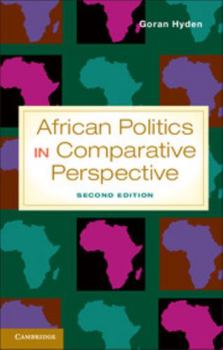
African Politics in Comparative Perspective. Gran Hydn

Select Format
Select Condition 
Book Overview
This revised and expanded second edition of African Politics in Comparative Perspective reviews fifty years of research on politics in Africa and addresses some issues in a new light, keeping in mind the changes in Africa since the first edition was written in 2004. The book synthesizes insights from different scholarly approaches and offers an original interpretation of the knowledge accumulated in the field. Goran Hyden discusses how research on African politics relates to the study of politics in other regions and mainstream theories in comparative politics. He focuses on such key issues as why politics trumps economics, rule is personal, state is weak and policies are made with a communal rather than an individual lens. The book also discusses why in the light of these conditions agriculture is problematic, gender contested, ethnicity manipulated and relations with Western powers a matter of defiance.
Format:Paperback
Language:English
ISBN:1107651417
ISBN13:9781107651418
Release Date:October 2012
Publisher:Cambridge University Press
Length:326 Pages
Weight:1.10 lbs.
Dimensions:0.8" x 6.0" x 8.9"
Customer Reviews
1 rating
African Worldview, Ethnicity and Social Dynamics
Published by Thriftbooks.com User , 18 years ago
While focusing on politics, this analysis provides insights on the cultural picture in Africa. A helpful chapter is Ch 9, "Ethnicity and Conflict," which provides a summary of approaches and working definitions of "ethnicity" in various disciplines of study. This provides a good reference point for evaluating the place of the concept of "ethnicity" in the political and social dynamics of the countries of Africa. Hyden provides a good analysis of data from a 50-year period, which enables him to suggest practical steps to improve development approaches from the donor nations and other cross-cultural projects. He urges that the cultural patterns and worldview concepts underlying the African societies and states be taken into account. Failed Aid Programs He finds that virtually all aid programs have failed to produce long-term effects in any country of Africa. He identifies and clarifies the African beliefs and worldview concepts that help account for that. Important among these is the blurring of formal and informal systems and structures, which is obvious to anyone who has lived any time in virtually any African country. It is especially helpful to see his analysis of the causes in the African cultures and societies for public accountability problems. African "Big Man" Politics He presents an astute and accurate portrait of the "Big Man" political concept dominant in Africa, and explains how this presents problems for donor-state ideas of accountability. He analyzes specific characteristics of every African political system and clarifies the actual operating assumptions and patterns in the formal systems and informal systems dominant in each country. There is a primary difference in concept of what the State is and how it should operate between the western and the African worldviews. Lack of awareness of or attention to this largely accounts for the misguided projects and failures. Practical Hyden concludes with 10 specific suggestions for planning and implementing development and international partnerships. He is concerned to help the African leaders understand how the non-African world will be thinking from their cultural worldview assumptions. He likewise tries to inform the international perspective of the value and consistency of the African points of view, based on different but consistent principles and practices form their experience. His practical analysis is specific, and he provides a map for planning for international agencies, United Nations and NGOs, as well as national leaders in Africa to better understand the limitations of the primarily western donors. Culture without Social Dynamics? One thing that puzzled me is that it seems that the use of the term "culture" is sometimes used in such a way as to exclude the broader social relationships. He contrasts social and cultural characteristics. What can this mean? What are cultural characteristics that can be separated from the social context they are inherent
Copyright © 2026 Thriftbooks.com Terms of Use
| Privacy Policy | Do Not
Sell/Share My Personal Information | Cookie Policy | Cookie Preferences | Accessibility Statement
ThriftBooks® and the ThriftBooks® logo are registered trademarks of Thrift Books Global, LLC
ThriftBooks® and the ThriftBooks® logo are registered trademarks of Thrift Books Global, LLC
