


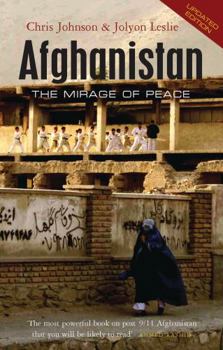
Afghanistan: The Mirage of Peace


Select Format
Select Condition 
Book Overview
Widely portrayed as the 'success of the war on terror', Afghanistan is now in crisis. Increasingly detached from the people it is meant to serve, and unable to manage the massive amounts of aid that... This description may be from another edition of this product.
Format:Hardcover
Language:English
ISBN:1842773763
ISBN13:9781842773765
Release Date:November 2004
Publisher:Zed Books
Length:256 Pages
Weight:0.95 lbs.
Dimensions:9.2" x 0.8" x 5.2"
Customer Reviews
1 rating
Useful study of how not to build a nation
Published by Thriftbooks.com User , 21 years ago
This absorbing book is written by two people who between them have worked for 20 years in aid agencies in Afghanistan. They criticise the post-war policies imposed by the US state. Even the UN Secretary-General decries `premature elections' and `cosmetic democracies'. Security in Afghanistan is now worse than for years. Opposition to the US/UN occupation is growing. The US-dominated World Bank insisted that all Afghanistan's pre-1979 debts be paid. The Bank says privatisation is the answer to government inefficiency and corruption, so they privatised the inefficiency and corruption! They even privatised the health service, despite the universal failures of health markets. Privatisation means governments spending our money to prop up private companies. Across the world, the evidence proves that privatisation grows private fortunes, not public services or economies, and that market liberalisation destroys societies and states. Nor is foreign aid the answer. In 2003, the US state allocated $1.6 billion for rebuilding Afghanistan, but most went to outside, mostly US, `consultants'. Only 10% resulted in finished projects. 83% of a $150 million Asian Development Bank loan for roads, power and gas went to foreign contractors. By 2002, 350 Non-Governmental Organisations, up from 46 in 1999, were competing for foreign aid funds. The authors rightly describe as `hopelessly idealistic' their own proposal that "the various international players [ugh!] have to leave their own agendas behind and start concentrating on Afghanistan." The UN's failures in Kosovo, East Timor and now Afghanistan prove that the failures are systemic: UN intervention is part of the problem. The authors' contradictory ideal of `participatory intervention' mirrors Blair's imperial claim of `humanitarian intervention'. The authors are right to say, "Fundamentally it is not donor money that Afghanistan needs but a working economy." But how? Not through the `new form of international engagement' that they suggest. The Afghan people need to get the foreign occupiers out so that they can freely decide their own future. But the authors, good little empire-building missionaries that they are, argue that withdrawal would be premature, always premature. Countries need sovereignty, not foreign patronage, democracy not foreign despotism.
Copyright © 2026 Thriftbooks.com
Terms of Use | Privacy Policy | Do Not Sell/Share My Personal Information | Cookie Policy | Cookie Preferences | Accessibility Statement
ThriftBooks ® and the ThriftBooks ® logo are registered trademarks of Thrift Books Global, LLC
ThriftBooks ® and the ThriftBooks ® logo are registered trademarks of Thrift Books Global, LLC
