


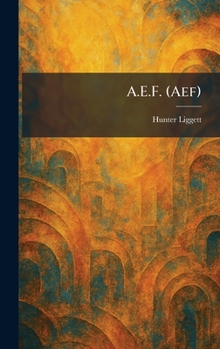
A.E.F. (Aef)

"A.E.F." offers an authoritative and detailed account of the American Expeditionary Forces' involvement in World War I, written by one of the conflict's most distinguished military leaders, Major General Hunter Liggett. As the commander of the First American Army, Liggett provides an invaluable insider's perspective on the strategic planning, logistical hurdles, and massive combat operations that defined the American military experience on the Western Front.
The work explores the complexities of mobilizing and leading a vast citizen army in a foreign theater, highlighting pivotal engagements such as the St. Mihiel and Meuse-Argonne offensives. Liggett's observations go beyond mere tactical reporting, offering profound insights into the leadership, discipline, and grit required to achieve victory in the face of modern industrial warfare. This narrative serves as a vital primary source for understanding the United States' emergence as a global military power and provides a clear-eyed look at the realities of the Great War. For historians and military enthusiasts, "A.E.F." remains a foundational text detailing the professionalization of the American soldier and the high-level strategic maneuvers that helped bring the war to a conclusion.
This work has been selected by scholars as being culturally important, and is part of the knowledge base of civilization as we know it. This work was reproduced from the original artifact, and remains as true to the original work as possible. Therefore, you may see the original copyright references, library stamps (as most of these works have been housed in our most important libraries around the world), and other notations in the work.
This work is in the public domain in the United States of America, and possibly other nations. Within the United States, you may freely copy and distribute this work, as no entity (individual or corporate) has a copyright on the body of the work.
As a reproduction of a historical artifact, this work may contain missing or blurred pages, poor pictures, errant marks, etc. Scholars believe, and we concur, that this work is important enough to be preserved, reproduced, and made generally available to the public. We appreciate your support of the preservation process, and thank you for being an important part of keeping this knowledge alive and relevant.
Customer Reviews
ThriftBooks ® and the ThriftBooks ® logo are registered trademarks of Thrift Books Global, LLC
