


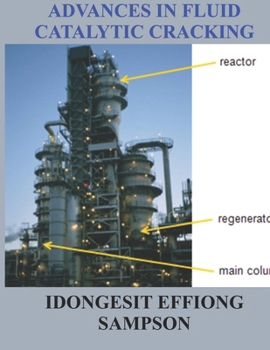
Advances in Fluid Catalytic Cracking: Fluid Catalytic Cracking
No Customer Reviews

The Fluidized Catalytic Cracking (FCC) has passed through a remarkable period of innovation which has resulted in its commanding the leading position as the primary and secondary refinery asset in most high conversion refineries.With FCC, heavy hydrocarbons are cracked to useful products. The gasoline produced is of high octane number. The history of this process began in one man's laboratory (Houndry) and was catapulted by the emergence of World War II into one of the primary means of producing aviation jet fuel. The prominence of the FCC unit continued to increase following the war within the refining world. The FCC unit has passed through a number of fundamental shifts in innovation including the advent of zeolite catalysis, residue cracking, residue upgradation, fluid catcracking, deep catalytic cracking and most recently, as an engine for producing chemical feed stock: Propylene Rich Feed (PRF). Butene Rich Feed (BRF) and decant oil besides fuel gas and coke. Additionally, world fuel markets are now shifting towards diesel which is once again providing a driving force for further innovation. While the FCC unit is a mature technology, it is far from stagnant. The coming decades are sure to continue this trend.
Format:Paperback
Language:English
ISBN13:9798879911176
Release Date:March 2024
Publisher:Independently Published
Length:76 Pages
Weight:0.44 lbs.
Dimensions:0.2" x 8.5" x 11.0"
Customer Reviews
0 rating
Copyright © 2026 Thriftbooks.com
Terms of Use | Privacy Policy | Do Not Sell/Share My Personal Information | Cookie Policy | Cookie Preferences | Accessibility Statement
ThriftBooks ® and the ThriftBooks ® logo are registered trademarks of Thrift Books Global, LLC
ThriftBooks ® and the ThriftBooks ® logo are registered trademarks of Thrift Books Global, LLC
