


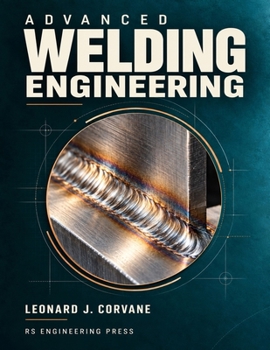
Advanced Welding Engineering: Welding Metallurgy, Joint Design, Process Qualification, and Structural Integrity
No Customer Reviews

Design welded systems with the physics, metallurgy, mechanics, and evidence working together.
A weld can meet visual expectations and still carry hidden risk. Heat input changes cooling and microstructure. Joint geometry and restraint reshape the load path. Alloy choice affects cracking, toughness, and corrosion. Qualification establishes a tested range, while inspection must connect indications to service consequences. Treating those decisions separately makes it harder to explain failures, control distortion, or defend an acceptance decision.
This advanced technical guide connects the complete engineering chain-from service requirements to production control and structural performance. It develops energy sources and arc behavior, heat flow, weld-pool dynamics, solidification, alloy response, process selection, numerical modeling, joint mechanics, residual stress, fatigue, fracture, corrosion, qualification, nondestructive examination, repair, automation, quality, economics, and safety. Throughout, assumptions and units are explicit, simplified estimates are separated from validated results, and uncertainty is treated as part of responsible engineering. Worked examples progress from quick hand calculations to computational cases, while decision workflows and reusable worksheets help readers organize requirements, define procedure windows, plan inspection, evaluate repairs, and communicate the basis for acceptance or escalation.
What you will learnTranslate service conditions into defensible material, process, consumable, and joint decisions.Estimate heat input, cooling behavior, thermal cycles, penetration trends, and solidification effects.Assess weldability in steels, stainless grades, aluminum, nickel, titanium, and dissimilar combinations.Model temperature, stress, and distortion with verification and validation built into the workflow.Connect joint design, fatigue, fracture, corrosion, inspection, acceptance, and repair to service performance.Integrate monitoring, robotics, traceable records, quality controls, cost, and safety into production planning.Inside the guideArc, resistance, solid-state, laser, and hybrid processesThermal-metallurgical transformations, cracking risks, and process windowsWeld-group design, fabrication detail, residual-stress control, and postweld treatmentWorked examples, computational cases, review problems, equations, and reusable worksheetsWho it is for
Upper-level and graduate engineering students, plus professionals in fabrication, design, process development, inspection, quality, reliability, and structural assessment who need a rigorous bridge from theory to qualified production.
Make welding decisions that are explainable, reviewable, traceable across disciplines, and fit for the intended service from qualification through long-term performance.
Format:Paperback
Language:English
ISBN:B0HMZDS8X2
ISBN13:9798162342441
Release Date:October 2026
Publisher:Independently Published
Length:476 Pages
Weight:2.41 lbs.
Dimensions:1.0" x 8.5" x 11.0"
Customer Reviews
0 rating
Copyright © 2026 Thriftbooks.com
Terms of Use | Privacy Policy | Do Not Sell/Share My Personal Information | Cookie Notice | Cookie Preferences | Accessibility Statement
ThriftBooks ® and the ThriftBooks ® logo are registered trademarks of Thrift Books Global, LLC
ThriftBooks ® and the ThriftBooks ® logo are registered trademarks of Thrift Books Global, LLC
